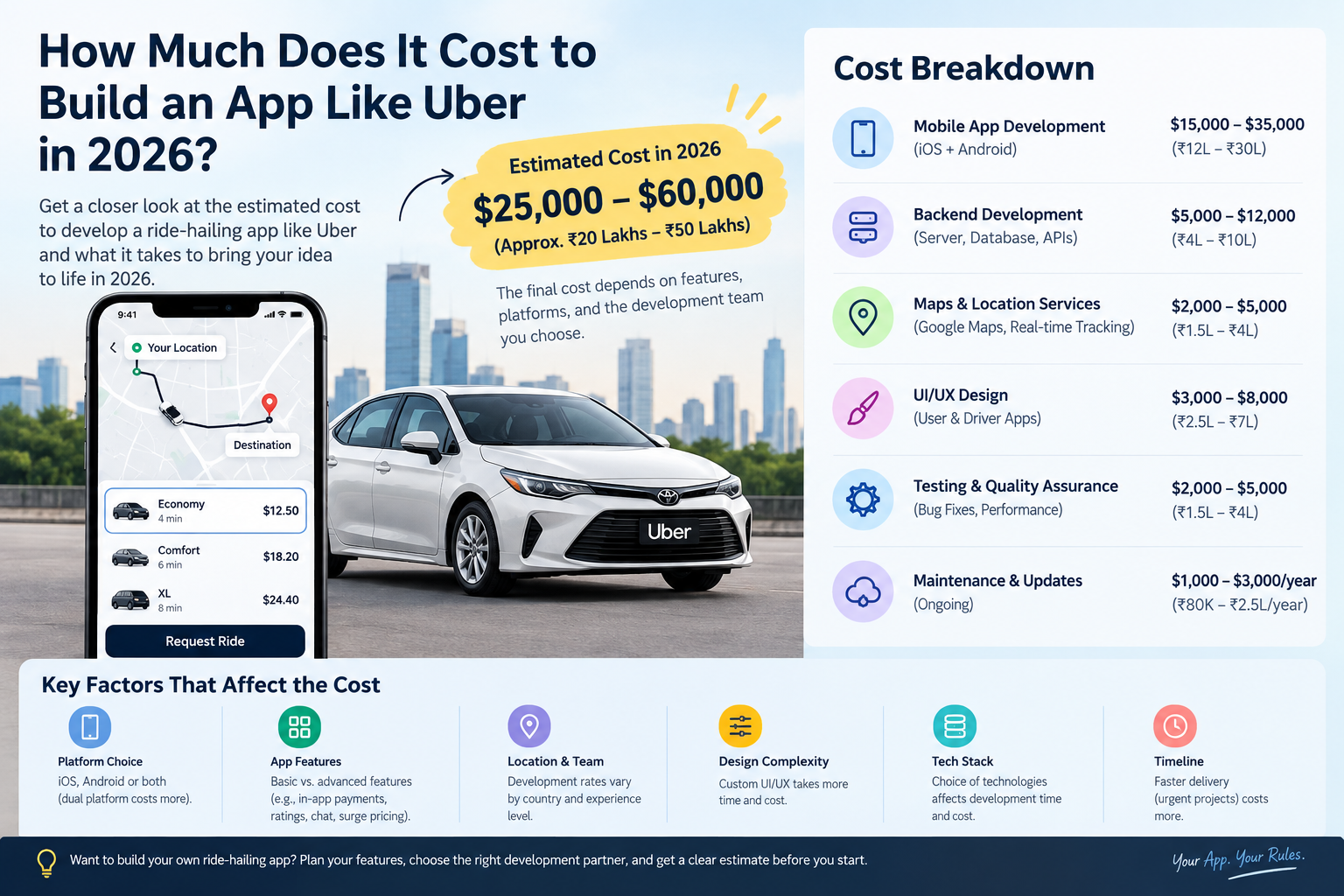
Building an app like Uber in 2026 is no longer simply a matter of putting a map on a smartphone and connecting passengers with drivers. A modern ride-hailing platform is a sophisticated digital ecosystem that combines real-time location tracking, route optimization, digital payments, driver management, automated pricing, notifications, identity verification, analytics, customer support, and increasingly, artificial intelligence.
So, how much does it actually cost to build an app like Uber in 2026?
A realistic estimate is $50,000 to $150,000 for a basic MVP, $150,000 to $350,000 for a feature-rich ride-hailing platform, and $350,000 to $700,000+ for a highly advanced solution designed to operate at large scale.

The final price depends heavily on the application’s features, design complexity, technology stack, development location, number of platforms, third-party integrations, security requirements, and the scale you expect from launch.
This guide breaks down the cost of building an Uber-like app in 2026 and explains where your development budget is likely to go.
What Makes an Uber-Like App Expensive?
Before discussing individual features, it is important to understand what you are actually building.
An Uber-style business usually requires several connected products rather than one application:
- A passenger app
- A driver app
- An administration dashboard
- A backend and API infrastructure
- Payment and billing systems
- Real-time location and dispatch services
- Customer support functionality
- Analytics and reporting tools
Each component has its own development requirements.
For example, a passenger needs to request a ride and track the driver. Meanwhile, the driver needs to receive trip requests, navigate to the passenger, change availability, review earnings, and complete the trip. The admin team needs an entirely different interface for managing drivers, customers, payments, pricing, complaints, promotions, and business performance.
That interconnected architecture is one of the primary reasons an Uber-like app costs significantly more than a conventional mobile application.
Cost of Developing the Passenger App
The passenger application is the customer-facing part of the platform.
A typical passenger app includes registration, profile management, location detection, ride booking, fare estimates, driver tracking, payments, trip history, ratings, promotions, and notifications.
User Registration and Profiles
Users should be able to register using email, phone number, or social authentication.
Development can include:
- Phone or email verification
- Passwordless authentication
- Profile management
- Saved addresses
- Emergency contacts
- Account settings
- Privacy preferences
Estimated cost: $3,000–$8,000
Maps and Location Tracking
Maps are at the heart of a ride-hailing application.
Users need to select pickup and destination points, view nearby drivers, estimate travel time, follow the vehicle in real time, and receive navigation-related information.
This usually requires integration with mapping and geolocation services.
Estimated cost: $8,000–$20,000
The ongoing cost of map APIs, geocoding, routing, traffic data, and location requests should also be included in the long-term operating budget.
Ride Booking and Dispatch
The booking engine determines how a ride request moves through the system.
The platform must identify suitable drivers, send ride requests, handle driver acceptance or rejection, update trip status, and notify the passenger at every stage. A well-designed Uber for X App can make this process more efficient by connecting the right drivers with customers quickly, improving response times, and creating a smoother, more reliable ride-booking experience.
Estimated cost: $10,000–$25,000
The complexity rises substantially if your platform supports scheduled rides, multiple vehicle categories, shared rides, corporate accounts, or sophisticated driver matching.
Fare Calculation
A ride-hailing platform needs a reliable pricing engine.
The basic calculation may include:
Base fare + distance + time + applicable fees = estimated trip price
More advanced systems can include dynamic pricing, peak-hour pricing, tolls, waiting charges, cancellation fees, location-based pricing, and promotional discounts.
Estimated cost: $7,000–$18,000
Cost of Developing the Driver App
The driver application is just as important as the passenger app because drivers are effectively the supply side of the marketplace.
Driver Registration and Verification
Driver onboarding can involve:
- Personal information
- Driver’s license verification
- Vehicle information
- Insurance documentation
- Background checks
- Identity verification
- Document expiration alerts
Estimated cost: $5,000–$15,000
The actual cost can be higher when external identity verification or regulatory compliance services are integrated.
Driver Availability and Ride Requests
Drivers need to switch between online and offline status, receive nearby trip requests, see pickup details, accept or reject rides, and receive updated instructions.
Estimated cost: $8,000–$20,000
Navigation and Trip Management
Once a driver accepts a trip, the app needs to support navigation, pickup confirmation, trip commencement, route updates, trip completion, and fare information.
Estimated cost: $8,000–$20,000
Driver Earnings
Drivers typically need an earnings dashboard showing completed trips, commissions, incentives, bonuses, adjustments, and payout information.
Estimated cost: $5,000–$12,000
Cost of the Admin Dashboard
The administration panel is often underestimated during the early planning stage.
However, it is essential for operating the marketplace.
Administrators may need to:
- Manage passengers
- Approve drivers
- Review documents
- Monitor active trips
- Configure pricing
- Manage commissions
- Handle refunds
- Process complaints
- Create promotions
- Monitor transactions
- View analytics
- Manage geographic service areas
Estimated cost: $15,000–$40,000+
A sophisticated admin dashboard can become a complete business operations platform, particularly when the service expands into multiple cities.
Payment Gateway Integration
A modern ride-hailing application may support cards, digital wallets, bank transfers, local payment methods, corporate billing, and cash payments depending on the target market.
Payment functionality needs to cover:
- Secure checkout
- Payment authorization
- Automatic charging
- Refunds
- Driver payouts
- Transaction history
- Invoices
- Payment failure handling
Estimated development cost: $5,000–$15,000, excluding transaction fees charged by payment providers.
Payment security is particularly important because the application handles sensitive financial information.
Push Notifications and Communication
Real-time communication keeps passengers and drivers informed.
Notifications may cover:
- Ride request confirmation
- Driver acceptance
- Driver arrival
- Trip started
- Trip completed
- Payment confirmation
- Promotional offers
- Account alerts
You may also need in-app chat or masked calling so passengers and drivers can communicate without unnecessarily exposing personal contact information.
Estimated cost: $4,000–$12,000
Ratings and Reviews
Two-sided marketplaces benefit from reputation systems.
Passengers can rate drivers, while drivers can potentially rate passengers. The platform can use these ratings to identify recurring problems, improve marketplace quality, and develop safety mechanisms.
Estimated cost: $3,000–$8,000
Advanced Features That Increase the Budget
The basic version of an Uber-like application is only the beginning. Several advanced capabilities can significantly increase development costs.
Artificial Intelligence
AI can be used for:
- Demand forecasting
- Driver positioning
- Fraud detection
- Customer support automation
- Personalized offers
- ETA prediction
- Driver churn prediction
- Intelligent route recommendations
- Pricing optimization
Depending on the sophistication of the AI system, implementation can add $15,000 to $75,000+ to the project.
The important distinction in 2026 is that AI should not simply be added as a marketing feature. It should solve measurable operational problems.
Scheduled Rides
Scheduled trips allow customers to book transportation in advance.
The backend must coordinate future demand with driver availability while handling cancellations, reassignment, reminders, and changing driver supply.
Estimated additional cost: $8,000–$20,000
Multiple Vehicle Categories
You may want to offer different services such as economy, premium, electric vehicles, larger vehicles, or specialized transportation.
This requires configurable pricing and dispatch rules.
Estimated additional cost: $5,000–$15,000
Corporate Accounts
Business transportation introduces features such as employee profiles, centralized billing, spending limits, invoices, approval workflows, and corporate reporting.
Estimated additional cost: $10,000–$30,000+
Multi-City and Multi-Country Support
Expanding geographically creates another layer of complexity.
You may need:
- Multiple currencies
- Multiple languages
- Regional pricing
- Different tax rules
- Local payment methods
- Regional driver requirements
- Location-specific policies
- Country-specific compliance
This can substantially increase both development and operational costs.
UI/UX Design Costs
Design is more than choosing attractive colors and creating screens.
A ride-hailing application needs a frictionless experience because users often book rides while walking, traveling, carrying luggage, or operating under time pressure.
Design work typically includes:
- User research
- Information architecture
- Wireframes
- User journeys
- High-fidelity UI
- Interactive prototypes
- Design systems
- Usability testing
A professional UI/UX phase can cost approximately $8,000–$30,000+, depending on the scope.
Spending more on UX early can actually reduce development waste because confusing workflows are identified before they become expensive code changes.
Technology Stack and Its Effect on Cost
Your technology choices also influence development speed, scalability, maintenance, and hiring requirements.
A modern solution may use:
Mobile: Flutter, React Native, Swift, or Kotlin
Backend: Node.js, Java, Python, Go, or similar technologies
Database: PostgreSQL, MySQL, MongoDB, Redis, or combinations of these
Cloud: AWS, Google Cloud, Microsoft Azure, or another cloud provider
Maps: A major mapping and navigation API provider
Payments: A payment gateway appropriate to the target market
There is no universally “best” technology stack.
For an MVP, cross-platform development can reduce the initial cost by allowing one codebase to support both iOS and Android. However, native development may make more sense when you require highly optimized platform-specific functionality or expect extensive long-term customization.
Development Team Cost
The location and structure of your development team can dramatically change the total budget.
A typical project may require:
- Product manager
- Business analyst
- UI/UX designer
- Mobile developers
- Backend developers
- QA engineers
- DevOps engineer
- Security specialists
- Project manager
Approximate development rates vary significantly by region.
For example, teams in North America and Western Europe commonly have higher hourly rates than teams in India, Eastern Europe, or Latin America.
Instead of selecting a team based solely on hourly cost, consider the total cost of ownership. A cheaper team that takes twice as long or produces unreliable software may ultimately cost more.
Hidden Costs You Should Include in Your Budget
The development quote is not the entire investment.
An Uber-like business also needs money for:
- Cloud hosting
- Maps and geolocation APIs
- SMS and email services
- Payment processing
- App-store fees
- Monitoring and logging
- Customer support
- Security testing
- Legal and compliance work
- Maintenance
- Bug fixing
- Marketing
- Driver acquisition
- Insurance and operational expenses
Post-launch maintenance can commonly require around 15%–25% of the original development budget annually, although the actual figure depends on the product’s complexity and growth.
How to Reduce the Cost of Building an Uber-Like App
You do not necessarily need to build every Uber-style feature before launching.
A smarter approach is to develop an MVP around the core marketplace.
Start with:
- Passenger registration
- Driver registration
- Basic verification
- Pickup and destination selection
- Ride requests
- Driver matching
- Real-time tracking
- Basic fare calculation
- Payments
- Ratings
- Notifications
- Admin management
Then gather real-world data.
Once you understand how customers and drivers behave, you can invest in advanced functionality such as AI-driven demand forecasting, loyalty programs, corporate transportation, scheduled rides, subscriptions, or sophisticated pricing.
This approach reduces upfront risk and allows product decisions to be based on actual usage rather than assumptions.
A Practical 2026 Budget Example
Imagine you want to launch an Uber-like service in one city.
You require:
- iOS and Android passenger app
- iOS and Android driver app
- Admin dashboard
- Real-time location
- Basic matching
- Card payments
- Ratings
- Push notifications
- Basic analytics
How Long Does It Take to Build an App Like Uber?
A basic MVP may take approximately 3–6 months.
A more complete ride-hailing platform may require 6–12 months, while a highly customized, enterprise-grade ecosystem can take 12–18 months or longer.
The development process generally follows these stages:
- Product discovery and requirements
- UX research and wireframing
- UI design
- Backend architecture
- Mobile application development
- Admin panel development
- API and third-party integrations
- Quality assurance
- Security and performance testing
- Deployment
- Post-launch monitoring and improvements
Trying to compress every stage into an unrealistically short timeline can create technical debt and quality problems.
Final Thoughts
So, how much does it cost to build an app like Uber in 2026?
For most businesses, the answer falls somewhere between $50,000 and $350,000, while sophisticated, large-scale platforms can exceed $700,000.
The biggest mistake is treating an Uber-like product as a single mobile app. It is actually a complete technology ecosystem connecting passengers, drivers, administrators, payment systems, maps, cloud infrastructure, analytics, and operational teams.
If your objective is to launch quickly, an MVP is usually the most practical starting point. Focus on the smallest version capable of completing the complete ride journey—from booking to driver matching, pickup, trip completion, and payment.
Once the product proves its can turn app development from a large upfront expense into a controlled, measurable investment. market fit, you can expand into AI-powered operations, advanced pricing, scheduled rides, corporate transportation, subscriptions, loyalty programs, and multi-city expansion.


