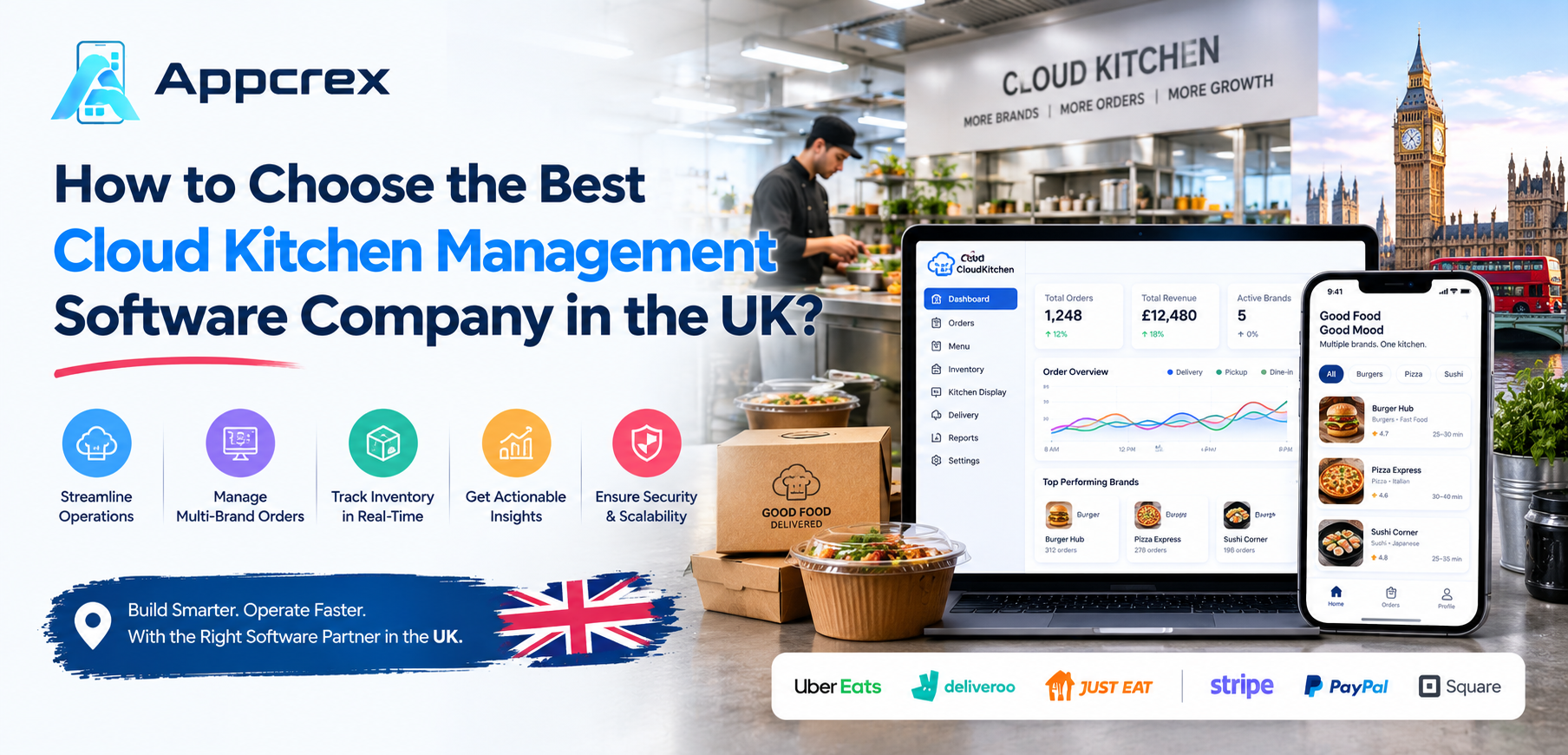
Cloud kitchens, also known as ghost kitchens or virtual kitchens, are changing how food businesses operate in the UK. Instead of relying on traditional dine-in spaces, cloud kitchens focus on delivery and takeaway orders, allowing businesses to operate multiple food brands from a single commercial kitchen.
However, managing multiple brands, online orders, delivery platforms, inventory, staff, menus, and customer data can quickly become complicated. This is where cloud kitchen management software can help.
Choosing the right cloud kitchen management software company in the UK is important for building an efficient, scalable, and reliable system. The right software can centralize operations, automate repetitive tasks, reduce errors, and provide better visibility into business performance.
This guide explains what to look for, which features matter, development costs, integrations, and questions to ask before choosing a cloud kitchen software company.
How Do You Choose a Cloud Kitchen Management Software Company in the UK?
To choose the best cloud kitchen management software company, evaluate its restaurant technology experience, software features, integration capabilities, scalability, security, customization options, pricing, and ongoing support.
Avoid choosing a provider based only on the lowest price. A cloud kitchen platform often needs to connect with food delivery services, payment systems, POS platforms, accounting software, inventory systems, kitchen displays, and customer-management tools.
A good development partner should understand both restaurant operations and cloud-based software development.
What Services Should a Cloud Kitchen Software Company Provide?
A professional cloud kitchen software company should be able to provide services such as:
- Cloud kitchen software development
- Restaurant management software
- Order management systems
- Kitchen display systems
- Inventory management
- Menu management
- Delivery management
- POS integration
- Payment gateway integration
- Customer relationship management
- Analytics and reporting
- Multi-brand management
- Third-party delivery integration
- Mobile and web applications
- Software maintenance and support
An experienced company should also be able to customize the platform according to your operational workflow rather than forcing your business to adapt to a rigid system.
What Features Should Cloud Kitchen Management Software Include?
The right feature set depends on the size and business model of your cloud kitchen. However, several features are particularly valuable.
1. Centralized Order Management
Cloud kitchens may receive orders from websites, mobile apps, and third-party delivery platforms.
A centralized order management system can bring these orders into one dashboard, helping staff process them without switching between multiple applications.
2. Multi-Brand Management
One kitchen may operate several virtual restaurant brands. The software should allow businesses to manage:
- Multiple brands
- Separate menus
- Brand-specific pricing
- Orders
- Promotions
- Performance reports
This makes it easier to operate several concepts from one location.
3. Kitchen Display System
A kitchen display system can send incoming orders directly to kitchen staff and organize them according to preparation stages.
This can improve communication between front-end ordering systems and kitchen operations while reducing manual order handling.
4. Inventory Management
Inventory management helps businesses monitor ingredients, stock levels, consumption, wastage, and purchasing requirements.
Automated stock alerts can also help kitchen managers identify when ingredients need to be reordered.
5. Menu Management
A centralized menu management system allows businesses to update prices, descriptions, availability, images, and ingredients across supported ordering channels.
This is especially useful for businesses managing multiple virtual brands.
6. Delivery Management
Delivery management features can help track orders, delivery status, drivers, estimated delivery times, and customer information.
Integration with third-party delivery services can further simplify order fulfillment.
7. Analytics and Reporting
Restaurant owners need visibility into business performance. Useful reports can include:
- Sales by brand
- Best-selling dishes
- Order volume
- Revenue
- Customer trends
- Ingredient usage
- Delivery performance
- Peak ordering times
These insights can help businesses make better operational and marketing decisions.
8. Customer Management
CRM functionality can help cloud kitchens understand customer behavior, manage customer profiles, track orders, and create targeted promotions.
Loyalty programs, personalized offers, and customer segmentation can also support retention.
What Integrations Does Cloud Kitchen Software Need?
Integrations are one of the most important considerations when selecting a cloud kitchen software company in the UK.
Depending on the business model, your platform may need integration with:
- POS systems
- Food delivery platforms
- Online ordering websites
- Mobile applications
- Payment gateways
- Accounting software
- Inventory systems
- Kitchen display systems
- CRM platforms
- Marketing tools
- Analytics platforms
Before hiring a software company, create a list of the platforms your business already uses and confirm that the development team can integrate them.
How Much Does Cloud Kitchen Management Software Cost in the UK?
The cost of developing cloud kitchen management software depends on its features, number of integrations, platforms, customization requirements, and technical complexity.

As a general planning estimate:
| Software Type | Estimated Development Cost |
|---|---|
| Basic Cloud Kitchen MVP | £25,000–£50,000 |
| Mid-Level Platform | £50,000–£100,000 |
| Advanced Cloud Kitchen System | £100,000–£200,000+ |
| Enterprise Multi-Brand Platform | £200,000+ |
A basic system may include order management, menu management, inventory, and reporting. More advanced platforms can include AI-powered analytics, multiple delivery integrations, sophisticated automation, loyalty programs, real-time dashboards, and multi-location management.
These figures are planning estimates rather than fixed UK market prices. A development company should provide a detailed quotation after understanding your requirements.
What Factors Affect Cloud Kitchen Software Development Cost?
Several factors influence the overall development budget.
Number of features: More functionality increases development and testing requirements.
Integrations: Connecting multiple delivery, POS, payment, accounting, and inventory systems can add considerable complexity.
Platforms: Web dashboards, mobile applications, kitchen displays, and admin panels each require development and testing.
Customization: A custom platform designed around your specific kitchen workflow generally requires more development than an off-the-shelf solution.
Automation and AI: AI-powered forecasting, demand prediction, recommendation systems, and automated reporting can increase development costs.
Security: The platform should protect business, customer, payment, and operational data through appropriate security measures.
How Can Cloud Kitchen Software Improve Restaurant Operations?
A well-designed management platform can help cloud kitchens:
- Centralize orders
- Reduce manual data entry
- Improve kitchen coordination
- Monitor inventory
- Manage multiple brands
- Track sales
- Automate repetitive tasks
- Improve customer service
- Analyze business performance
- Scale to additional locations
The main benefit is operational visibility. Instead of relying on separate systems and spreadsheets, managers can monitor important activities through a centralized platform.
Also Read : Cloud Application Development Company: Complete Guide to Services, Cost & Development Process
How Long Does It Take to Develop Cloud Kitchen Management Software?
A basic cloud kitchen management MVP may take approximately 3–5 months to develop.
A more advanced platform with multiple integrations, mobile applications, analytics, automation, and multi-brand functionality may require 6–12 months or more.
A typical development process includes:
- Business and technical discovery
- Feature planning
- UI/UX design
- Backend architecture
- Web and mobile development
- Third-party integrations
- Testing and quality assurance
- Deployment
- Staff onboarding
- Maintenance and updates
Starting with an MVP can help businesses validate the system before investing in advanced features.
What Should You Ask Before Hiring a Cloud Kitchen Software Company?
Before selecting a development partner, ask:
- Have you developed restaurant or food-delivery software before?
- Can you show relevant case studies?
- Which POS and delivery platforms can you integrate?
- Can the software support multiple virtual brands?
- How will inventory and order data be synchronized?
- What technology stack do you recommend?
- Is the platform scalable for multiple locations?
- How will customer and business data be secured?
- What is included in the development estimate?
- Who owns the source code and intellectual property?
- Do you provide maintenance and technical support?
- How will future integrations be added?
The answers can help you determine whether the company is capable of supporting your long-term growth.
Common Mistakes to Avoid
Businesses often make the following mistakes when selecting cloud kitchen software:
- Choosing software based only on price
- Ignoring third-party integrations
- Building unnecessary features in the first version
- Not planning for multiple brands
- Underestimating inventory requirements
- Ignoring data security
- Choosing software that cannot scale
- Failing to plan for ongoing maintenance
- Not testing the system with real kitchen workflows
A clear MVP strategy can help control costs while leaving room for future expansion.
FAQs About Cloud Kitchen Management Software in the UK
How much does cloud kitchen management software cost in the UK?
A custom cloud kitchen platform can cost approximately £25,000 to £200,000+, depending on features, integrations, customization, and scalability requirements.
What is the most important feature of cloud kitchen software?
Centralized order management is one of the most important features because it helps businesses manage orders from multiple channels in one place.
Can cloud kitchen software manage multiple brands?
Yes. A properly designed platform can support multiple virtual brands, menus, pricing structures, orders, inventory, and performance reports from a single kitchen.
Can cloud kitchen software integrate with delivery platforms?
Yes. Custom software can integrate with supported food delivery, POS, payment, accounting, and other third-party systems through APIs or available integration methods.
How long does it take to build cloud kitchen software?
A basic MVP can take around 3–5 months, while a sophisticated multi-brand platform can require 6–12 months or longer.
Is custom cloud kitchen software better than off-the-shelf software?
Custom software can be a better option when a business has unique workflows, multiple brands, complex integrations, or long-term scalability requirements. Off-the-shelf software may be suitable for businesses with simpler operational needs.
Final Thoughts
Choosing the best cloud kitchen management software company in the UK requires looking beyond features and pricing. Businesses should evaluate restaurant technology experience, integration capabilities, scalability, security, customization, development methodology, and ongoing support.
The best approach is to first identify the biggest operational challenges, define the core features required for an MVP, and then build the platform around real kitchen workflows.
With the right technology partner, cloud kitchens can centralize operations, manage multiple brands, automate repetitive processes, improve order accuracy, and gain the insights needed to scale efficiently in the competitive UK food-delivery market.