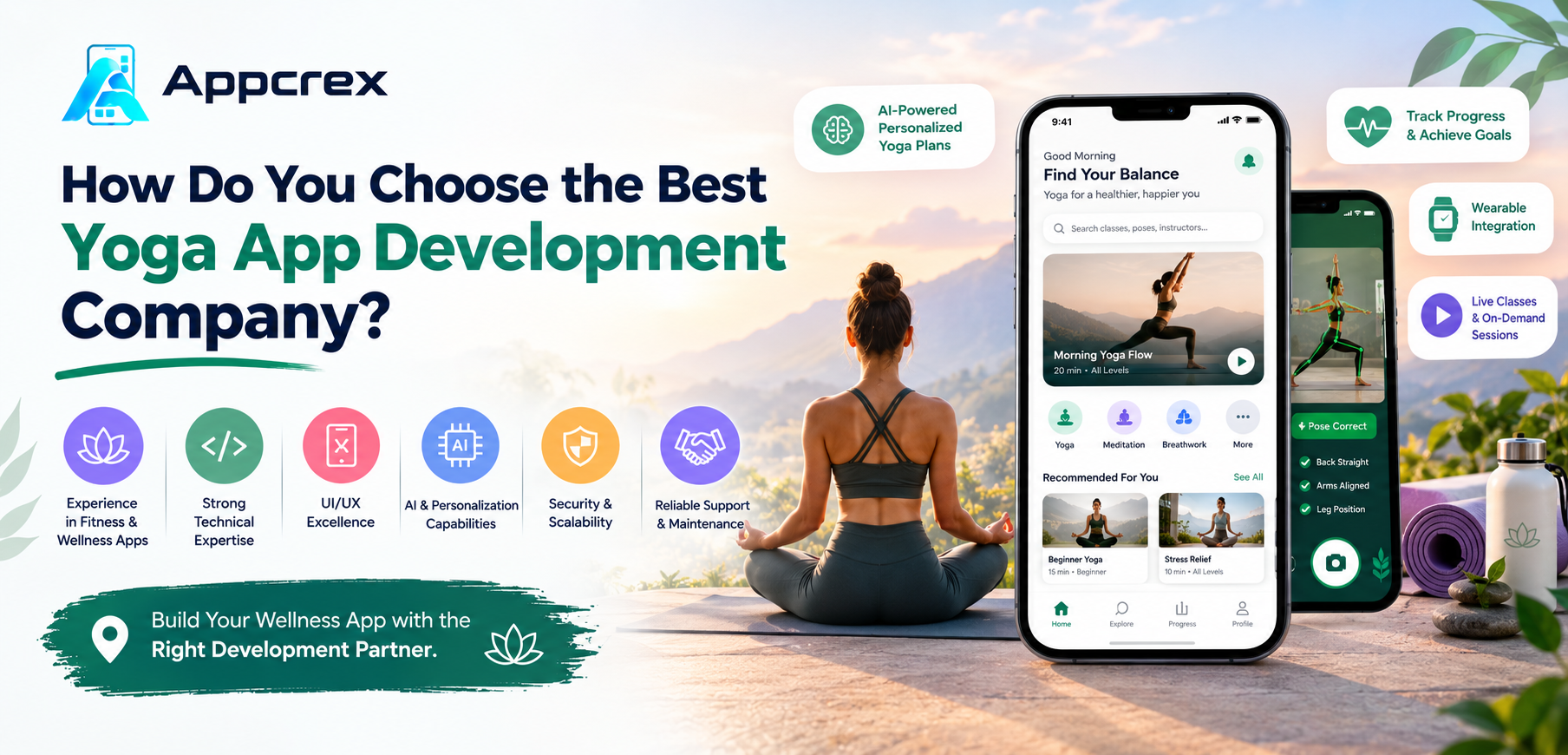
The growing popularity of digital wellness has created strong opportunities for yoga studios, fitness brands, wellness startups, and entrepreneurs to launch dedicated yoga applications. A modern yoga app can offer guided sessions, personalized routines, live classes, meditation, progress tracking, subscriptions, and even AI-powered recommendations.
However, building a successful yoga app requires more than hiring any mobile app developer. The right yoga app development company should understand fitness technology, user experience, video delivery, personalization, security, and the business model behind wellness applications.
This guide explains how to choose the right development partner, what features to consider, how AI can be used, development costs, timelines, and the questions you should ask before starting your project.
Can AI Be Used in Yoga App Development?
Yes. AI can be used in yoga app development to provide personalized workouts, posture guidance, recommendations, progress analysis, and virtual coaching.
Some practical AI-powered features include:
- Personalized yoga routines
- AI yoga instructors or virtual assistants
- Pose recognition
- Posture correction
- Personalized recommendations
- Progress analysis
- Smart workout scheduling
- AI-powered meditation recommendations
- Voice-based coaching
- Adaptive difficulty levels
Computer vision can potentially analyze a user’s movements through a smartphone camera and provide feedback on whether a pose is being performed correctly. However, such features require careful testing and should be designed as wellness guidance rather than a substitute for professional medical or therapeutic advice.
AI can make a yoga app more personalized, but it should solve a genuine user problem rather than being added simply as a marketing feature.
What Features Should a Yoga App Include?
The ideal feature set depends on the target audience and business model. However, several features can make a yoga app more useful and engaging.
1. User Profiles
Users should be able to create profiles, select goals, set preferences, and track their yoga journey.
Goals could include:
- Flexibility
- Strength
- Relaxation
- Stress management
- Better sleep
- General wellness
2. Guided Yoga Classes
The application can provide video-based yoga sessions organized by:
- Difficulty
- Duration
- Yoga style
- Fitness goal
- Instructor
- Body focus
This makes it easier for users to find sessions suitable for their needs.
3. Live Yoga Classes
Live streaming can help yoga instructors connect with users in real time. Businesses can offer scheduled classes, instructor-led sessions, and interactive experiences.
4. Yoga Pose Library
A searchable pose library can provide information about individual poses, including demonstrations, instructions, difficulty levels, and recommended sequences.
5. Meditation and Breathing Exercises
Yoga applications can expand beyond physical workouts by including meditation, breathing exercises, relaxation sessions, and mindfulness content.
6. Progress Tracking
Users can track completed sessions, practice duration, streaks, goals, and other activity metrics.
Progress dashboards can encourage users to maintain consistent practice.
7. Personalized Recommendations
A recommendation engine can suggest classes based on a user’s previous activity, goals, preferred duration, and difficulty level.
8. Subscription Management
For monetized applications, businesses can offer:
- Monthly subscriptions
- Annual memberships
- Free trials
- Premium classes
- Instructor content
- Exclusive programs
9. Wearable Integration
Depending on the app’s purpose, integration with supported health and wearable platforms can provide additional activity information and help users monitor their overall wellness.
10. Social Features
Community groups, challenges, achievements, instructor following, and sharing can help create a stronger sense of engagement.
How Do You Choose the Best Yoga App Development Company?
Choosing the right development partner requires evaluating more than pricing.
1. Check Industry Experience
Look for a company with experience in fitness, wellness, healthcare, or lifestyle app development. Experience with similar applications can help developers understand common UX and technical requirements.
2. Review the Portfolio
Ask to see previous mobile applications and relevant case studies.
Pay attention to:
- UI/UX quality
- App performance
- Feature complexity
- Video functionality
- Subscription systems
- User engagement features
- AI capabilities
A strong portfolio can provide evidence of practical development experience.
3. Evaluate Technical Expertise
Your development partner should have experience with technologies required for your application, such as:
- iOS development
- Android development
- Cross-platform development
- Cloud infrastructure
- APIs
- AI and machine learning
- Computer vision
- Video streaming
- Payment integration
The company should also be able to explain why a particular technology stack is suitable for your project.
4. Assess UI/UX Capabilities
A yoga app should feel calm, intuitive, and easy to navigate.
Users should be able to quickly find a class, start a session, track progress, and manage their account without unnecessary complexity.
5. Check Integration Experience
Ask whether the development company can integrate:
- Payment gateways
- Video streaming services
- Health platforms
- Wearables
- Analytics tools
- Push notifications
- CRM systems
- Social login
Integration requirements should be discussed before development begins.
6. Understand Security Practices
Yoga apps may collect personal profiles, payment information, activity data, and potentially health-related information.
Ask the development company about:
- Data encryption
- Secure authentication
- API security
- Access controls
- Payment security
- Data storage
- Privacy practices
- Security testing
Security should be part of the architecture from the beginning.
7. Compare Cost and Timeline
Do not automatically choose the company offering the lowest quote.

Instead, compare:
- Features included
- Development methodology
- Team experience
- Testing
- Support
- Maintenance
- Technology stack
- Estimated timeline
A detailed proposal makes it easier to compare companies fairly.
How Much Does It Cost to Develop a Yoga App?
The cost depends on the application’s features, platforms, integrations, design, and complexity.
As a general planning estimate:
| Yoga App Type | Estimated Development Cost |
|---|---|
| Basic Yoga App MVP | $25,000–$50,000 |
| Mid-Level Yoga App | $50,000–$100,000 |
| Advanced Yoga App | $100,000–$200,000+ |
| AI-Powered Yoga Platform | $150,000–$300,000+ |
A basic MVP may include user profiles, yoga videos, search, progress tracking, and subscriptions.
An advanced platform could include AI recommendations, pose recognition, live classes, wearable integration, community features, and sophisticated analytics.
These figures are planning estimates rather than fixed development prices. A development company should provide a customized estimate after reviewing the project requirements.
What Factors Affect Yoga App Development Cost?
Several factors can influence the final budget.
Number of features: More features require additional design, development, testing, and maintenance.
AI functionality: Pose recognition and personalized AI recommendations can require specialized development.
Video: High-quality video hosting, streaming, downloads, and live classes can increase infrastructure and development requirements.
Platforms: Building for both iOS and Android can increase the overall development effort.
Integrations: Wearables, payment systems, analytics, health platforms, and third-party APIs can add complexity.
UI/UX: A highly customized experience with animations, interactive workouts, and personalized dashboards requires additional design work.
How Long Does It Take to Develop a Yoga App?
A basic yoga app MVP can take approximately 3–5 months to develop.
A more advanced platform with AI, live streaming, wearable integrations, subscriptions, and community features may take 6–12 months or longer.
A typical development process includes:
- Product discovery
- Requirements planning
- UI/UX design
- Backend development
- Mobile app development
- AI and third-party integrations
- Testing
- Deployment
- Launch
- Maintenance and improvements
Starting with an MVP allows businesses to validate the concept before investing in more advanced functionality.
How Can a Yoga App Help Grow a Wellness Business?
A yoga application can create new revenue and engagement opportunities for yoga studios, instructors, wellness brands, and fitness businesses.
Potential benefits include:
- Reaching users beyond physical studio locations
- Offering paid memberships
- Selling premium classes
- Creating instructor-led programs
- Increasing customer retention
- Providing personalized experiences
- Expanding into new markets
- Collecting useful product analytics
- Building a digital wellness community
A hybrid business model can combine physical classes with digital subscriptions to create multiple revenue streams.
What Should You Ask Before Hiring Yoga App Developers?
Before signing a contract, ask potential development companies:
- Have you built fitness or wellness apps before?
- Can you show relevant case studies?
- Can you integrate video and live streaming?
- Can you build AI-powered features?
- Can you integrate wearable and health platforms?
- What technology stack do you recommend?
- How will user data be protected?
- What is included in the development estimate?
- How will additional requirements affect the cost?
- Do you provide testing and maintenance?
- Who owns the source code and intellectual property?
- What support will be available after launch?
The answers can help you determine whether the company is suitable for your product and long-term business goals.
Common Mistakes to Avoid
Businesses planning a yoga app often make these mistakes:
- Choosing a developer based only on price
- Adding too many features to the first version
- Ignoring UI/UX
- Underestimating video infrastructure
- Adding AI without a clear purpose
- Neglecting data security
- Not defining the target audience
- Failing to plan monetization
- Ignoring ongoing maintenance
- Not testing the application with real users
A focused MVP can help reduce initial investment while leaving room for future expansion.
Also Read : How to Make a Yoga App in the USA: Features, Cost & Development Process
FAQs About Yoga App Development
Can AI be used in a yoga app?
Yes. AI can support personalized routines, recommendations, virtual coaching, progress analysis, and pose recognition.
How much does it cost to develop a yoga app?
A yoga app can cost approximately $25,000 to $300,000+, depending on its features, platforms, integrations, AI capabilities, and complexity.
How long does it take to build a yoga app?
A basic MVP can take around 3–5 months, while an advanced application may require 6–12 months or longer.
What is the most important feature of a yoga app?
High-quality guided sessions, simple navigation, personalization, progress tracking, and a reliable user experience are among the most important features.
Can a yoga app offer live classes?
Yes. Live video streaming can allow instructors to conduct real-time yoga classes and interact with users.
Can yoga apps integrate with smartwatches?
Yes. Depending on the platform and available APIs, yoga applications can integrate with supported wearable and health ecosystems.
Final Thoughts
Choosing the best yoga app development company requires looking beyond development price. Businesses should evaluate industry experience, portfolio quality, UI/UX expertise, technical capabilities, AI experience, integrations, security, scalability, and post-launch support.
The best strategy is to start by identifying your target audience and core business goal. Build an MVP around the features users need most, then introduce advanced capabilities such as AI personalization, pose recognition, live classes, wearable integration, and community features as the product grows.
With the right development partner, a yoga app can become a scalable digital wellness platform that helps users practice consistently while creating new opportunities for businesses to grow and monetize their services.