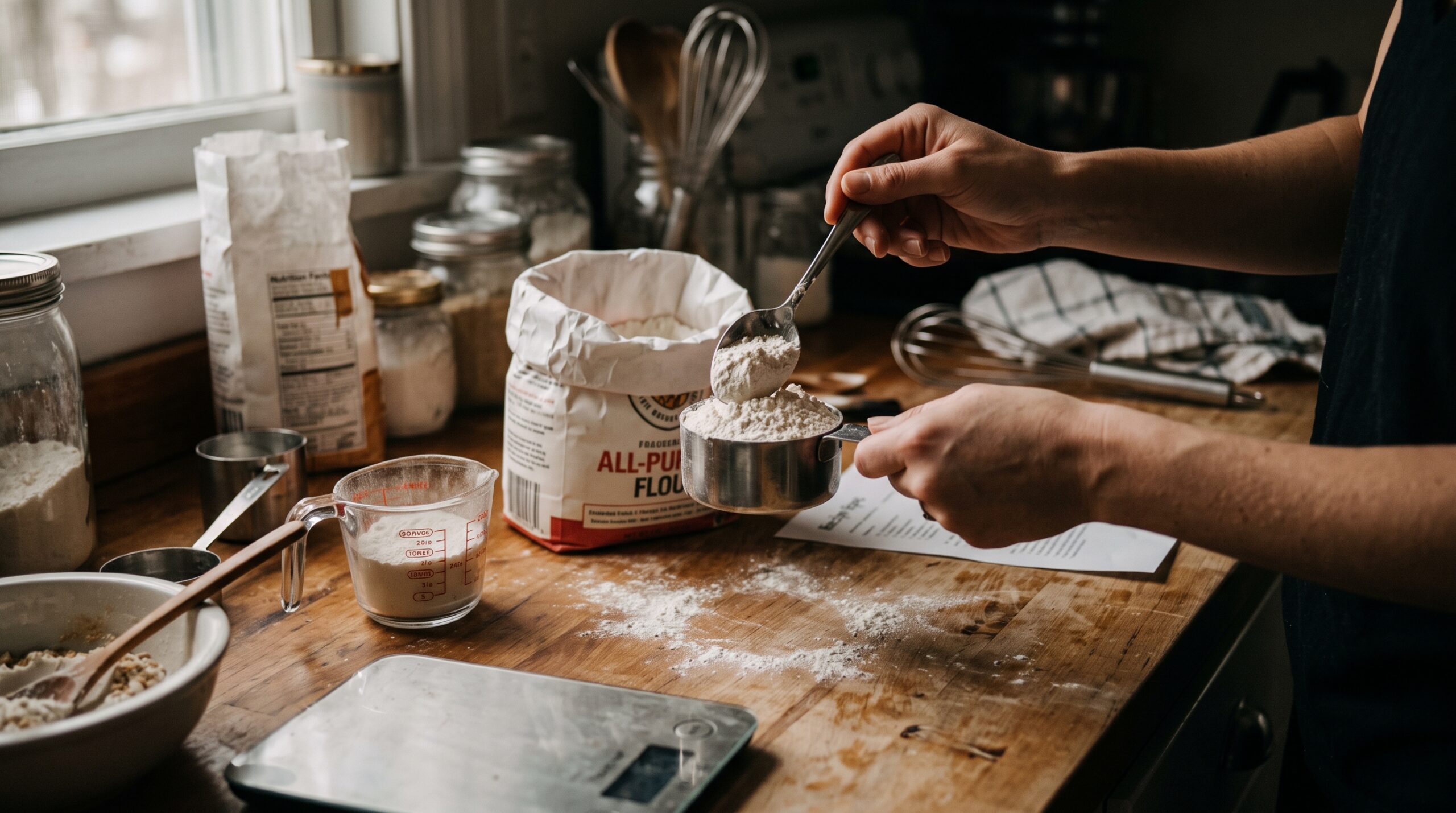
You find a promising chocolate cake recipe, gather your ingredients, and start measuring. Everything looks straightforward until you reach one instruction: add 150 grams of flour.
Your kitchen scale has stopped working, but you have measuring cups. Can you simply convert those 150 grams into cups and carry on?
Yes, but there’s something important to understand first.
Grams and cups measure two different things, and the ingredient you’re measuring determines the conversion. Getting that detail right can make a noticeable difference, especially when baking bread, cookies, or cakes.

Here’s how to handle grams to cups conversions without turning a simple recipe into a guessing game.
Why Grams and Cups Aren’t Interchangeable
Grams measure weight. Cups measure volume.
Imagine filling a cup with flour and another with sugar. Both ingredients occupy the same amount of space, but they don’t weigh the same.
Flour is relatively light, with air trapped between its particles. Granulated sugar is denser, so more weight fits into the same cup.
For example, using common US baking measurements:
- 1 cup of all-purpose flour weighs approximately 120 grams.
- 1 cup of granulated sugar weighs approximately 200 grams.
- 1 cup of butter weighs approximately 227 grams.
This explains why a universal grams-to-cups formula doesn’t work for every ingredient.
If a recipe asks for 100 grams of flour, that’s approximately 0.83 US cups. However, 100 grams of sugar is only about half a cup.
Using the same conversion for both would change the balance of your recipe.
How Many Cups Is 100 Grams?
It’s one of the most common kitchen conversion questions, but there isn’t one answer.
The result depends on what you’re measuring.
Here’s a practical reference chart using approximate values for common ingredients.
| Ingredient | 100 Grams Equals |
|---|---|
| All-purpose flour | 0.83 cups |
| Granulated sugar | 0.50 cups |
| Butter | 0.44 cups |
| Water | 0.42 cups |
| Milk | 0.42 cups |
| Honey | 0.29 cups |
| Unsweetened cocoa powder | 1.19 cups |
These figures use US cups and rounded ingredient weights. Actual measurements can vary slightly depending on the product and how it is handled.
The takeaway is simple: always identify your ingredient before converting its weight into volume.
A Better Way to Convert Grams to Cups
You can calculate conversions manually, but there’s a more convenient approach when you’re cooking.
Start by checking which ingredient your recipe specifies. Then use a reference that accounts for its weight per cup.
For example, an ingredient-based grams to cups converter allows you to select foods such as flour, sugar, butter, or rice before entering the required weight.
Instead of applying one general formula, it calculates the volume using the selected ingredient’s density reference. The tool also supports different cup standards, which can be useful when following recipes published in other countries.
This approach is particularly helpful when you are converting several ingredients from the same recipe.
What if You Prefer Calculating Manually?
The formula is straightforward:
Cups = Grams ÷ Grams per Cup
Suppose you need 180 grams of all-purpose flour.
Using the common reference of 120 grams per US cup:
180 ÷ 120 = 1.5 cups
You would measure approximately 1½ cups of flour.
The important part is knowing the correct grams-per-cup reference for your ingredient.
The Measuring Mistake That Can Ruin a Cake
Even when you’ve converted the numbers correctly, the way you fill your measuring cup matters.
Flour is a good example.
If you push a measuring cup directly into a tightly packed flour bag, you may collect more flour than the recipe intended.
The cup still looks full, but the additional weight can make your cake dense or your cookies dry.

A more reliable method is to loosen the flour, spoon it gently into the measuring cup, and level the surface with a straight edge.
Don’t shake or press the flour down unless the recipe specifically tells you to.
This technique helps you get closer to the expected volume-to-weight relationship.
For reference, King Arthur Baking’s ingredient weight chart lists one cup of all-purpose flour as 120 grams and recommends weighing ingredients when possible.
Don’t Forget That Cup Sizes Differ Around the World
There’s another detail that can cause confusion: not every country uses the same cup size.
A standard US customary cup holds approximately 236.6 milliliters, while a metric cup commonly holds 250 milliliters.
That might not sound like a major difference, but it can become more noticeable when a recipe requires several cups of liquid.
For example, three cups of water would be approximately:
- US cups: 710 milliliters
- Metric cups: 750 milliliters
That’s a difference of about 40 milliliters.
If you’re using an international recipe, check whether the author specifies US, metric, or another measuring standard.
When the original recipe provides gram measurements, following those weights is often the simplest way to avoid confusion.
Five Practical Tips for More Consistent Baking
Accurate conversions are useful, but good measuring habits matter just as much.
1. Use a kitchen scale when possible
A digital kitchen scale removes much of the uncertainty around measuring dry ingredients. You can measure flour, sugar, and butter directly in the amounts the recipe requires.
2. Measure liquids at eye level
Use a liquid measuring jug on a flat surface. Read the measurement at eye level rather than looking down into the jug.
3. Follow ingredient-specific measuring instructions
Packed brown sugar and loosely spooned flour are measured differently. Look for words such as packed, sifted, or chopped before measuring.
4. Check the ingredient’s condition
A cup of chopped walnuts won’t necessarily weigh the same as a cup of whole walnuts. Similarly, cooked rice and uncooked rice have different weight-to-volume relationships.
5. Keep the original recipe measurements
When adapting a recipe, save the original gram quantities alongside your converted cup measurements. If the results aren’t quite right, you’ll have a reliable reference for your next attempt.
When Should You Use Grams Instead of Cups?
Both measurement systems have their place.
Cups are convenient for quick cooking, especially when you’re preparing dishes where small variations won’t cause problems.
Grams are particularly useful for baking recipes that depend on specific ingredient ratios.
Bread dough, delicate cakes, pastries, and some cookies can be sensitive to differences in flour or liquid quantities.
If your recipe already provides measurements in grams and you own a working scale, there’s usually no reason to convert them.
But when a scale isn’t available, an ingredient-specific conversion can help you use the measuring tools you already have.
Frequently Asked Questions
Is 100 grams always half a cup?
No. One hundred grams equals approximately half a US cup of granulated sugar, but about 0.83 cups of all-purpose flour. The conversion depends on the ingredient.
How many cups is 200 grams of flour?
Using 120 grams per US cup, 200 grams of all-purpose flour equals approximately 1.67 cups. For greater accuracy, weigh the flour whenever possible.
Does 1 cup equal 250 grams?
Not necessarily. A metric cup has a volume of 250 milliliters, but that doesn’t mean every ingredient in the cup weighs 250 grams. Weight depends on the ingredient’s density.
Are cups accurate enough for baking?
Cups can work well when you use the measuring method intended by the recipe. However, a digital scale generally offers better consistency, especially for flour and other dry ingredients.
Final Thoughts
Converting grams to cups isn’t complicated once you understand what the numbers represent.
The main thing to remember is that the same weight doesn’t always occupy the same volume.
A cup of flour, a cup of sugar, and a cup of butter may look similar in size, but their weights are different.
Check the ingredient, use the correct cup standard, and pay attention to how you fill your measuring tools.
Those small habits can help you follow unfamiliar recipes more confidently and get more consistent results in the kitchen.