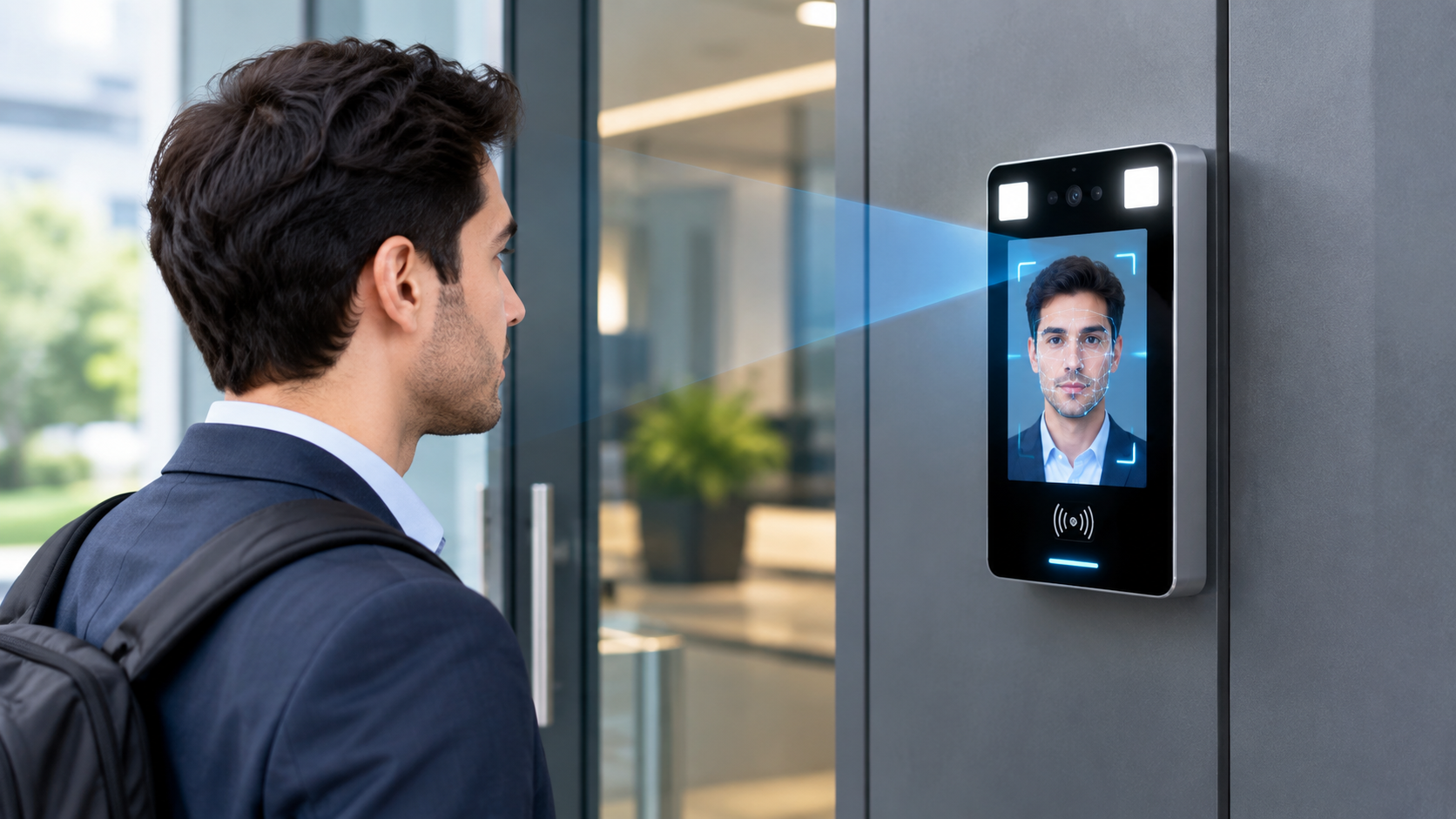
Face recognition door access uses biometric technology to verify a person’s identity before granting entry to a restricted space. Unlike keycards or PINs, it cannot be shared, stolen, or forgotten. In high-security environments — server rooms, data centres, pharmaceutical vaults, or government facilities — this layer of authentication significantly reduces the risk of unauthorised access and insider threats.
Why Traditional Access Methods Fall Short in Restricted Zones
Keycards get cloned. PINs get shared. Even two-factor authentication involving a physical token can be defeated if the token changes hands. For most general office areas, these risks are manageable. But in high-security areas, the cost of a single breach — whether it is stolen IP, compromised infrastructure, or a regulatory violation — can far outweigh years of operational savings.
Singapore’s facilities and security managers increasingly face pressure to meet compliance requirements under frameworks like the Cyber Security Agency of Singapore (CSA) and industry-specific standards such as MAS TRM and the Building and Construction Authority’s security guidelines for critical infrastructure. Physical access control is no longer just an operational concern — it is a governance issue.

How Face Recognition Door Access Adds a Real Security Layer
Face recognition door access works by capturing a live image at the point of entry, mapping unique facial geometry, and matching it against an enrolled biometric template in real time. The key word is live. Modern systems include liveness detection, which means a printed photo or a video replay will not trigger access. The door responds only to the person physically present.
This matters enormously in restricted area access scenarios where the stakes are high. When someone enters a network operations centre or a pharmaceutical cold storage room, you need to know it was genuinely that person — not someone using borrowed credentials.
What Makes It Different from Other Biometric Methods
Fingerprint scanners require physical contact, which raises hygiene concerns and can fail with worn or wet fingertips. Iris recognition is accurate but requires users to position themselves precisely. Facial recognition is contactless, fast (typically under one second), and works without the person needing to do anything beyond facing the camera.
For high-traffic secure zones — think a semiconductor fabrication facility in Woodlands or a data centre in Jurong — throughput speed matters alongside security strength. Face recognition handles both.
Use Cases: Where Facial Recognition Security Delivers the Most Value
Not every door needs biometric protection. But certain environments have no business relying on anything less.
1. Data Centres and Server Rooms
Singapore is a regional data hub. With over 60 commercial data centres operating across the island, the concentration of sensitive data in a small geography makes physical intrusion a serious threat vector. Face recognition ensures that only authorised engineers and technicians pass through cage doors and server room entrances — and every entry is timestamped with a verified identity.
2. Pharmaceutical and Biomedical Facilities
Singapore’s Biopolis and Tuas Biomedical Park house some of the region’s most sensitive research environments. Controlled substances, experimental compounds, and proprietary research require strict chain-of-custody tracking. Facial recognition security ties every access event to a confirmed individual, creating an audit trail that satisfies both internal compliance and regulatory inspection requirements.
3. Financial Institutions and Trading Floors
Under MAS Technology Risk Management guidelines, financial institutions in Singapore are expected to implement robust access controls for systems handling material data. Facial recognition at the physical perimeter of trading floors and core banking infrastructure rooms adds a layer that card-based systems simply cannot replicate.
4. Government and Defence-Adjacent Facilities
For facilities operating near or within Singapore’s defence and critical infrastructure ecosystem, the requirement for verified, logged access is non-negotiable. Facial recognition systems integrated with visitor management and alarm platforms create a cohesive security posture rather than a patchwork of disconnected controls.
Key Features to Look for in a High-Security Facial Access System
Not all face recognition systems are built for high-security environments. Here is what separates enterprise-grade solutions from consumer-grade products:
| Feature | Why It Matters for High-Security Zones |
|---|---|
| Liveness Detection | Prevents spoofing via photos or video playback |
| Anti-Passback Control | Stops tailgating by ensuring one-in, one-out logic |
| Integration with Access Control Panels | Works with existing door hardware and alarm systems |
| Audit Logging | Time-stamped, identity-linked records for compliance |
| Local Processing (Edge AI) | Reduces latency and dependency on cloud connectivity |
| Multi-Factor Option | Combines face with card or PIN for ultra-secure zones |
Addressing Common Concerns from Facility Managers
What About Privacy and Data Storage?
This is a legitimate concern in Singapore, where the Personal Data Protection Act (PDPA) governs the collection and use of biometric data. Enterprise facial recognition systems designed for access control typically store only encrypted mathematical templates — not actual photographs. Employees are enrolled with consent, and data retention policies can be configured to meet PDPA obligations.
How Does It Perform in Real Conditions?
Modern systems handle varying lighting, glasses, masks, and aging without significant accuracy loss. In a controlled entry environment — a dedicated door camera with consistent framing — performance is very reliable. Most enterprise-grade systems report false acceptance rates below 0.001%, which means the chance of the wrong person getting through is extremely low.
Is It Difficult to Integrate with Existing Infrastructure?
Most commercial facial recognition terminals support standard protocols such as Wiegand and OSDP, which means they connect directly to existing access control panels. Integration with HR databases for automatic enrolment and de-provisioning is also standard in enterprise deployments, reducing the administrative burden on security teams.
High Security Access Control Starts at the Door
The most sophisticated cybersecurity stack is undermined the moment an unauthorised person walks through a physical door. High security access control is not just about the perimeter fence or the CCTV system — it is about knowing, with certainty, who entered a sensitive space and when.
Facial recognition closes the gap between identity and access. It replaces assumption — “this person has a valid card, so they must be authorised” — with verification: “this person’s face matches the enrolled template for this door, at this time.”
For Singapore security managers and facility managers overseeing environments where a single access breach carries serious operational or regulatory consequences, that shift from assumption to verification is not optional — it is the baseline.
Beril Engineering, delivered through the BDE Tech platform, provides face recognition access control solutions tailored to high-security commercial and industrial environments in Singapore. Their deployments combine reliable hardware with system integration expertise suited to the practical demands of facilities managers.
Frequently Asked Questions
Q1: Is face recognition door access suitable for all types of high-security areas?
Yes. Face recognition door access is effective in data centres, pharmaceutical facilities, financial institutions, and government buildings. It provides contactless, real-time identity verification and generates audit logs. This makes it suitable for environments that require restricted-area access and compliance documentation.
Q2: How does facial recognition security comply with Singapore’s PDPA?
Facial recognition access systems store encrypted biometric templates, not photographs, and require user consent during enrolment. Organizations can configure defined retention periods and restrict access to stored data to align these systems with Singapore’s Personal Data Protection Act requirements for biometric data handling.
Q3: Can a face recognition system be spoofed using a photograph?
Enterprise-grade systems include liveness detection technology, which distinguishes a live face from a static image or video. This makes spoofing through photographs or screen playback extremely difficult, ensuring that only the physically present, enrolled individual can gain access to a secured door.
Q4: How does face recognition compare to keycard access in high-security environments?
People can lose, clone, or share keycards, creating security gaps. Face recognition links access directly to a verified individual and prevents people from transferring access. For high-security areas, facial recognition provides a stronger, more accountable access control method than card-based systems alone.
Q5: What happens if the face recognition system fails or goes offline?
Most enterprise systems include offline operation modes, storing templates locally on the device. Organizations can configure backup authentication methods such as PINs or cards as fallback options. This maintains access during connectivity interruptions without compromising the overall security posture of the facility.
Q6: How long does it take to enrol employees into a face recognition access system?
Organizations can typically complete enrolment in under a minute per person using a camera-based capture process. Many systems integrate with HR platforms for bulk enrolment and automatic de-provisioning when employees leave — reducing the ongoing administrative workload for facility and security management teams.