How much does a speaker upgrade actually change the experience? That question gets answered differently depending on who you ask, but spending time with a well-set-up audio system versus a factory one makes. The gap obvious in a way that’s hard to unsee. Or unhear, more accurately. The clarity on vocals, the definition in the low end, the way instruments sit separately in a mix rather than blending into one vague wash of sound — none of that is what factory speakers are designed to produce.
They’re designed to pass a spec review at a price point. That’s a different brief entirely.
What Factory Car Speakers Actually Are
Most original equipment speakers for cars are full-range drivers doing too much with too little. A 5.25-inch paper cone handles everything from bass to treble simultaneously, mounted in a door cavity that was designed around the panel structure, not around acoustic performance. The output is adequate. Adequate is not the same as good.
The frequency response on a typical OEM speaker rolls off significantly below 100Hz and above 15kHz. Both ranges where music has texture and presence. A quality replacement car speaker set extends that range at both ends, and the difference is audible on almost any genre. Not just bass-heavy music. Acoustic tracks and vocal recordings in particular reveal the limitation of factory drivers faster than anything else.
Coaxial vs Component — The Trade-Off Worth Understanding
Coaxial car speakers put the tweeter and woofer in the same housing. One mounting point, simpler wiring, straightforward installation. The trade-off is imaging — when highs and lows come from the same point in the door panel at roughly knee height, the stereo field collapses toward the floor rather than sitting at ear level.
Component speakers separate the two drivers. The woofer stays in the door, the tweeter mounts higher — sail panel, A-pillar, somewhere close to ear level — and a passive crossover divides the signal between them. The stereo imaging improves noticeably because high frequencies are directional, and your ears use timing differences between the two channels to locate sound in space. A tweeter at floor level defeats that entirely.
For car audiophile speaker setups, component speakers are the usual choice. For anyone who wants a meaningful improvement without the installation complexity, a quality coaxial is still a significant step up from factory.
Car Speakers With Amplifier — Why This Pairing Matters
Speakers for cars in India are often run directly off the head unit’s internal amplification, which is fine for moderate listening levels. Push the volume past about 70–75%, and most head units start clipping — sending a distorted signal that damages tweeters over time and sounds harsh at higher volumes. It’s one of the more common causes of tweeter failure.
Car speakers with amplifier pairing solve this cleanly. More headroom, lower distortion at higher volumes, and better control over the low end of the car speakers with a woofer configuration, particularly. Amplifier sensitivity matching matters here — a speaker with 89dB sensitivity needs roughly twice the amplifier power to produce the same output as one rated at 92dB. Most buyers don’t factor this in when speccing a system.
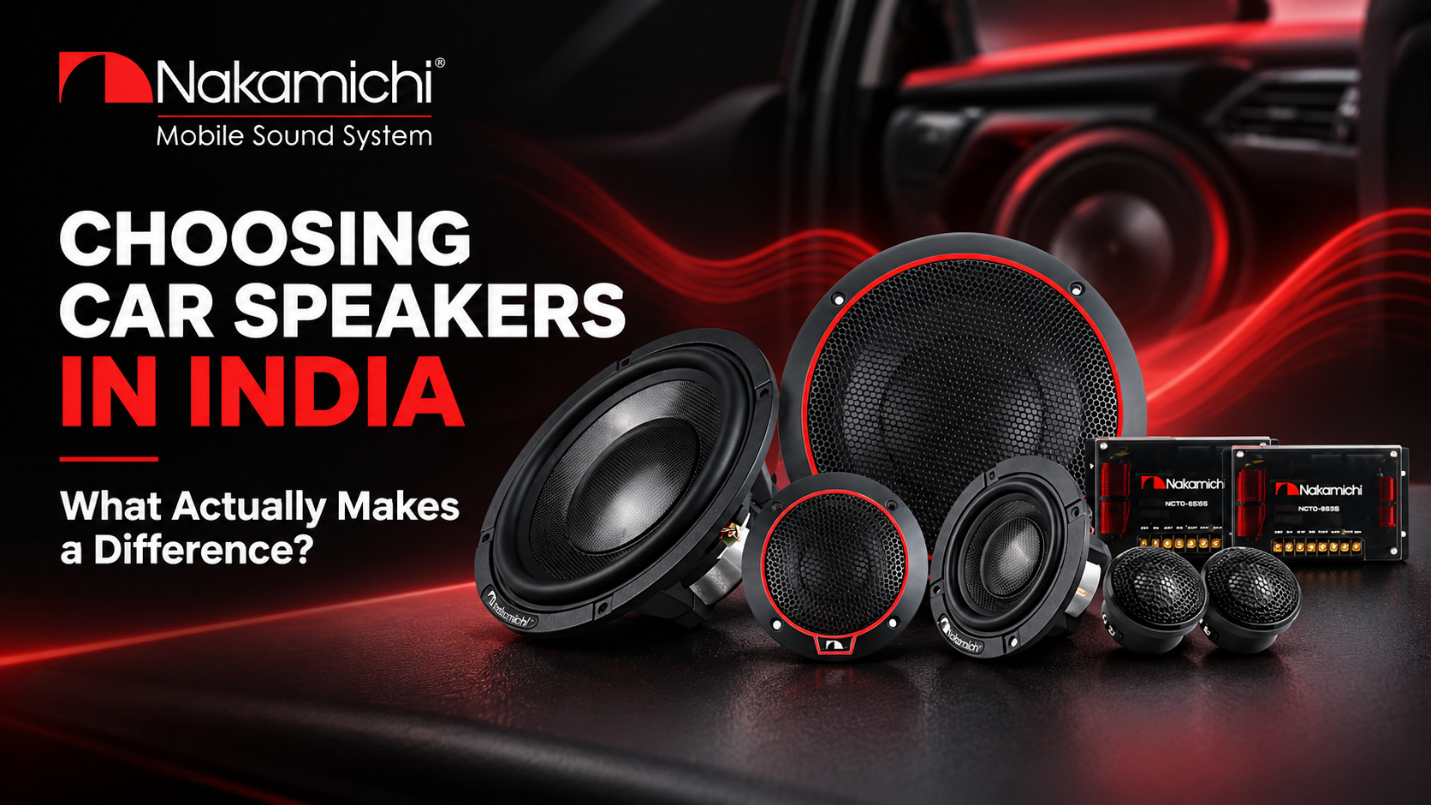
Nakamichi’s approach to this has been to build amplification directly into the speaker, matched at the manufacturing stage rather than left to individual installation choices. It’s a practical solution for buyers who want properly powered speakers for cars without the added complexity of speccing and wiring a separate amplifier chain.

Don’t forget about impedance. Most car speakers are rated at 4 ohms. Some budget units claim 2 ohms to show higher power figures, but a 2-ohm load stresses head unit amplifiers and cheaper external amps. Sticking with 4-ohm speakers for cars in India is the less risky choice unless the amplifier is specifically rated for lower impedance loads.
What the Upgrade Actually Sounds Like
We have heard enough before-and-after comparisons over the years to say this without much qualification: a properly fitted car speaker set from a quality brand, running adequate power, sounds like a different vehicle. Not marginally better. Noticeably different in the way that makes driving with music on feel like less of a compromise.
That gap is what a speaker upgrade is actually solving — not just more volume, but music that sounds like music rather than background noise competing with road noise.
FAQs
Do I need to change all four car speakers at once?
Not necessarily — upgrading the front pair makes the most difference to perceived sound quality since your ears face forward. Rear speakers contribute less to imaging and more to fill. Start with the fronts and decide whether the rears need attention after.
What sensitivity rating should I look for in speakers for cars in India?
88–92dB is the practical range for most setups. Higher sensitivity means louder output from the same amplifier power, which matters if you’re running off a head unit rather than a dedicated amp.
Can car audiophile speakers be fitted in stock mounting locations?
Usually yes for 6.5-inch and 5.25-inch sizes, which cover most popular Indian car models. Depth clearance behind the door panel is the measurement that actually matters, not just the diameter. Check both before buying.
How much does professional installation cost compared to DIY?
Front speaker swap is manageable DIY — door panel removal, connector swap, refitting. Component speaker installation with tweeter mounting is more involved and worth professional fitting for a clean result. Labour costs vary, but a full front component install typically runs ₹1,500–3,000 at most car audio workshops.
Will new car speakers with woofer need to be broken in?
Yes, to an extent. Most drivers loosen slightly over the first 10–20 hours of use, and the bass response fills out a bit. Run them at moderate volume initially rather than immediately pushing them hard. The difference isn’t dramatic, but it’s real.