Dubai has rapidly developed into a major technology and business hub, with companies across real estate, healthcare, retail, finance, logistics, hospitality, and e-commerce exploring artificial intelligence to improve customer experiences and automate business processes. The UAE has also established national and Dubai-level AI initiatives, creating a strong environment for businesses adopting AI-powered solutions.
For businesses considering an AI-powered mobile application, one of the first questions is usually: How much does AI app development cost in Dubai?
The answer depends on the application’s complexity, AI technology, features, integrations, data requirements, and security needs.
How Much Does AI App Development Cost in Dubai?
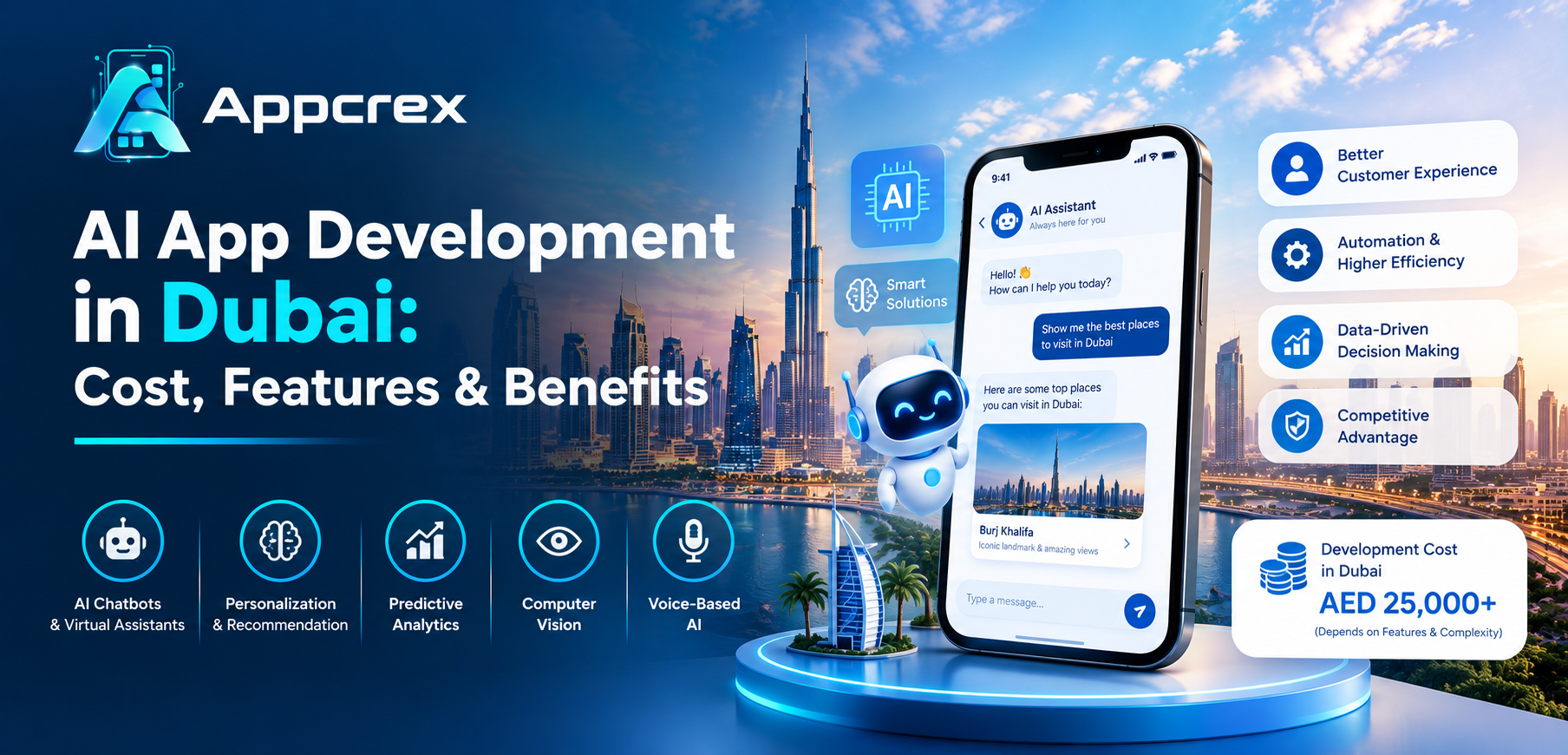
In 2026, AI app development costs in Dubai can range from approximately AED 25,000 for a focused MVP to AED 300,000 or more for complex enterprise applications. Some highly specialized platforms involving custom AI models, extensive integrations, or regulated industries can cost considerably more.
A general planning range looks like this:
| AI App Type | Approximate Cost |
|---|---|
| Basic AI MVP / Chatbot | AED 25,000–50,000 |
| Mid-level AI Application | AED 80,000–150,000 |
| Advanced AI Application | AED 150,000–300,000+ |
| Enterprise AI Platform | AED 300,000+ |
These figures are planning estimates rather than fixed prices. A chatbot using an existing AI model is very different from an application requiring computer vision, custom machine learning, proprietary data, or multiple enterprise integrations.
What Factors Affect AI App Development Cost?
Several factors influence the final development budget.
1. AI Technology
The type of AI being implemented has a major impact on cost.
A business may use:
- Generative AI
- AI chatbots
- Recommendation engines
- Predictive analytics
- Natural language processing
- Computer vision
- Voice recognition
- AI-powered search
- Document intelligence
Using an existing AI model through an API can significantly reduce development time compared with training or fine-tuning a custom model. For many business applications, an API-based approach is sufficient for the initial product.
2. App Features
The AI component is only one part of the application.
Other features can include:
- User registration and authentication
- Profiles
- Payments
- Push notifications
- Location services
- In-app chat
- Booking systems
- Dashboards
- Analytics
- Admin panels
The more functionality an app requires, the more development, testing, and integration work is involved.
3. Arabic and English Support
Businesses targeting the Dubai market may want applications that support both Arabic and English.
This can involve additional UI/UX work, right-to-left layouts, Arabic language testing, localization, and AI evaluation. For conversational applications, the AI model also needs to provide an appropriate experience across both languages.
4. Integrations
Many AI applications need to connect with existing business systems.
For example, an AI application might integrate with:
- CRM platforms
- ERP systems
- Payment gateways
- E-commerce platforms
- Cloud services
- Customer support software
- Business databases
Deep integrations can increase both development complexity and testing requirements.
5. Data and Security
AI applications often depend on business data. Preparing, cleaning, structuring, and securely processing that data can become a significant part of the project.
Businesses handling sensitive information should also consider authentication, encryption, access controls, monitoring, backups, and applicable UAE data-protection requirements.
Essential Features of an AI-Powered Mobile App
Not every application needs every AI feature. The right functionality should be based on the business problem being solved.
Some useful AI-powered features include:
AI Chatbots
AI assistants can answer customer questions, provide product information, support bookings, and automate common customer-service requests.

Personalized Recommendations
Recommendation engines can analyze user behavior and suggest products, services, content, or offers based on individual preferences.
Predictive Analytics
Businesses can use AI to identify patterns, forecast demand, analyze customer behavior, and support data-driven decision-making.
AI Search
Intelligent search can help users find products, documents, services, or information using natural-language queries rather than relying only on exact keywords.
Computer Vision
Computer vision can be used for image recognition, document processing, identity-related workflows, visual inspection, and other specialized applications.
Voice-Based AI
Voice assistants can allow users to interact with an application through spoken commands, which can be useful in customer service, navigation, accessibility, and hands-free workflows.
Benefits of AI App Development for Dubai Businesses
AI-powered applications can provide several potential advantages.
Improved Customer Experience
AI can provide faster responses, personalized recommendations, and 24/7 assistance, helping businesses serve customers more efficiently.
Greater Automation
Repetitive processes such as customer queries, document processing, lead qualification, and data classification can be partially automated.
Better Decision-Making
AI can analyze large amounts of information and identify patterns that may be difficult to discover manually.
Increased Efficiency
Automating routine tasks can allow employees to focus on higher-value activities such as sales, strategy, and customer relationships.
Competitive Advantage
Businesses that implement AI effectively can differentiate their products and services through personalization, automation, and smarter digital experiences.
How Long Does It Take to Build an AI App?
Development time depends heavily on complexity.
A basic AI application using an existing model may take around 8–12 weeks, while a mid-level application can require approximately 12–18 weeks. More complex enterprise platforms involving custom AI, extensive integrations, or specialized compliance requirements may take six months or longer.
The development process generally includes:
- Business and technical requirements
- AI strategy and technology selection
- UI/UX design
- Backend development
- AI integration
- Testing and optimization
- Security testing
- Deployment
- Post-launch monitoring and maintenance
How to Choose an AI App Development Company in Dubai
Choosing the right development partner is just as important as defining the application’s features.
Businesses should evaluate a company’s:
- AI and mobile development expertise
- Previous projects
- Technology stack
- UI/UX capabilities
- Security practices
- Integration experience
- Communication process
- Post-launch support
- Pricing transparency
Instead of choosing a company based only on the lowest quotation, businesses should compare the scope, technology approach, timeline, support, and expected long-term costs.
It is also useful to ask whether the development team recommends an existing AI model, a customized solution, or a hybrid approach. In many cases, starting with an existing foundation model can help businesses validate an idea before investing in custom AI infrastructure.
Also Read : AI Training App Development Guide: How Enterprises Can Upskill Employees with AI
Final Thoughts
AI app development in Dubai offers businesses opportunities to improve customer experiences, automate processes, and build more intelligent digital products. However, there is no single development price that applies to every AI application.
A focused AI MVP may start at around AED 25,000, while more sophisticated applications can require AED 80,000–300,000 or significantly more depending on the scope.
The best approach is to define the business problem first, prioritize the AI features that directly address it, and then choose the technology and development strategy accordingly. This helps businesses control their initial investment while creating a foundation that can scale as the product and customer base grow.