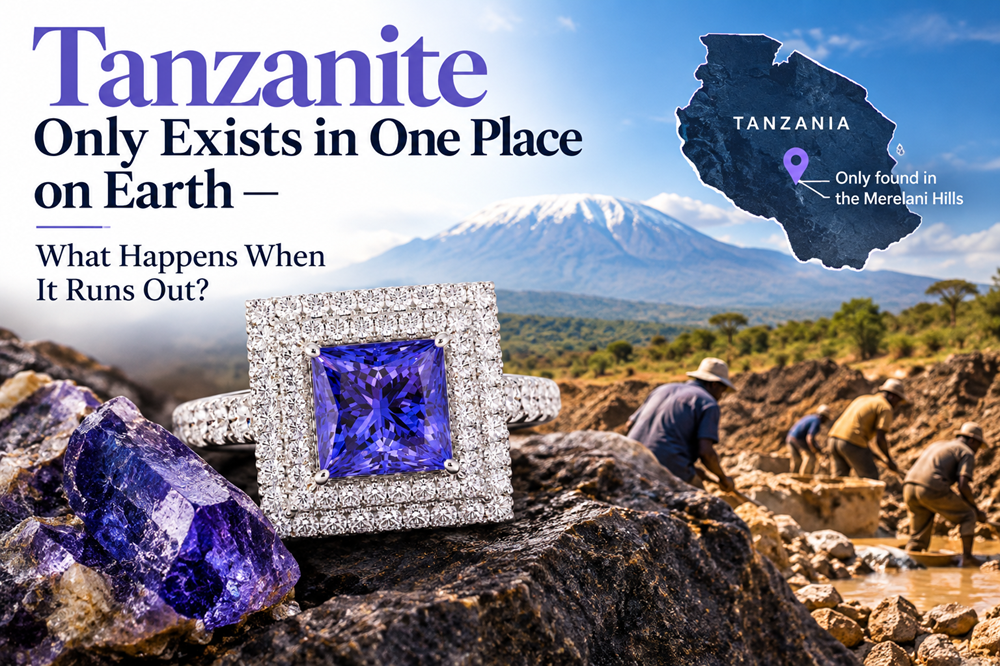
Somewhere in northern Tanzania, at the foot of Mount Kilimanjaro, lies a strip of land only a few kilometres wide. It’s the only place on the entire planet where tanzanite has ever been found. The tanzanite eternity rings, the pendants, and every loose stone ever sold anywhere in the world came out of that single hillside. Geologists have been discussing for years how much longer tanzanite can be produced from that hillside. For years, geologists have been debating the expected duration of tanzanite production from that hillside to produce tanzanite.
A Rarity Story That Isn’t Marketing Spin
It’s easy to be sceptical when a gemstone seller claims that something is “incredibly rare”, because sellers use the phrase so loosely that it has almost lost its meaning. Tanzanite’s rarity is different because it’s not a claim about desirability. It’s a claim about geology, and it happens to be true in a way that’s genuinely unusual even within the gem world.
One Hillside, and Nowhere Else
Diamonds are mined across many countries like Russia, Botswana, Canada, Australia, and more. Sapphire comes from Sri Lanka, Madagascar, Myanmar, Australia, and several other sources. Tanzanite comes from one place: a strip of land in the Merelani Hills, discovered by chance in 1967 after Maasai herders noticed unusual blue crystals following a bush fire. Every single tanzanite crystal that has ever existed, or ever will, has to come from that one location. No other deposit exists anywhere else in the world, as scientists have yet to identify another location on Earth with the geological conditions needed to produce tanzanite.
How Close Is “Running Out”, Actually?
This is the part where honesty matters more than a clean headline number, because estimates genuinely vary.

A Range, not a Countdown
Estimates of how much longer Merelani can sustain commercially viable tanzanite production have varied over the years, typically ranging from 15 to 30 years, with more conservative projections extending to around 50 years. These estimates depend on factors such as mining depth, market prices and whether miners discover new sections of the deposit connected to the existing geological structure. However, one trend remains consistent: extraction is becoming deeper and more challenging, with mining operations now reaching depths that would have seemed extreme just a few decades ago.
Why “Eventually” Still Matters Today
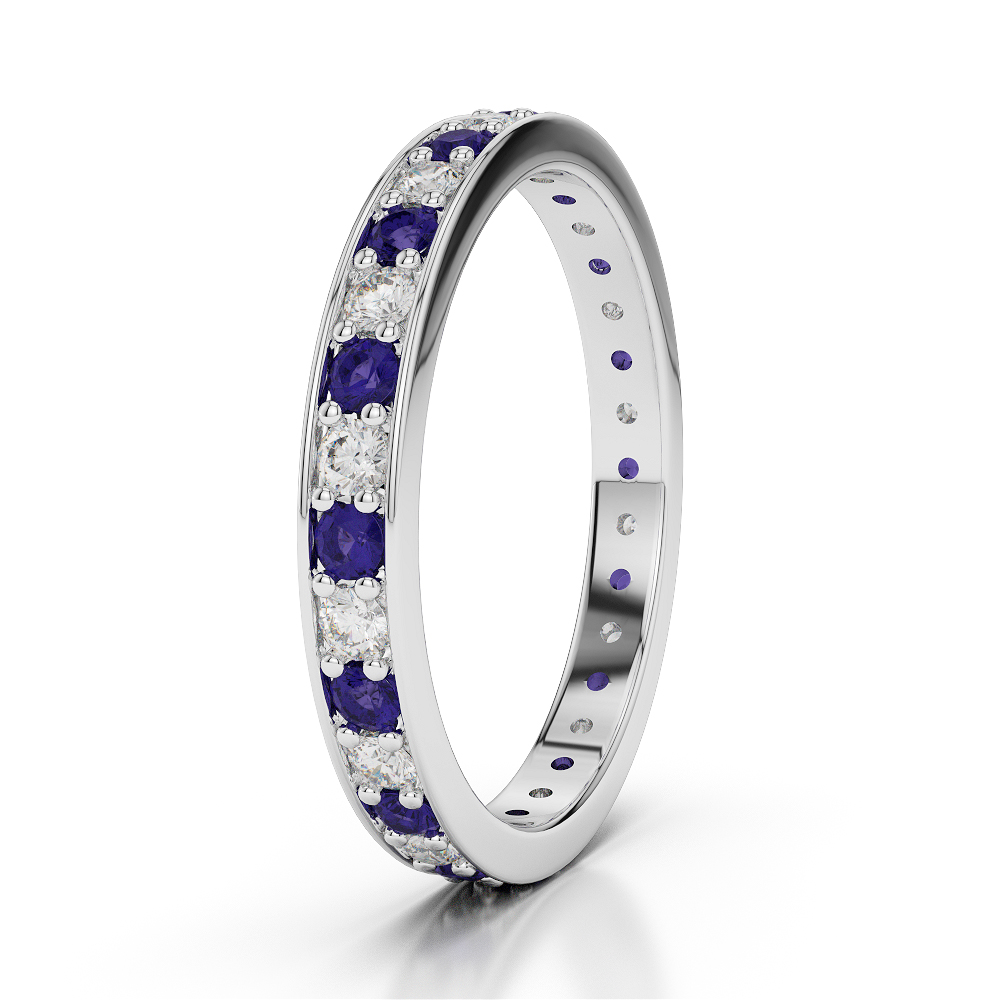
None of these factors means tanzanite is about to disappear tomorrow and you won’t be seeing the tanzanite eternity rings or bracelets. But it does mean the supply is genuinely finite in a way that most gemstones simply aren’t, and that reality is already shaping how serious buyers and collectors think about the stone, which means treating a well-cut piece less like a purchase and more like something worth holding onto.
What This Means for a Tanzanite Eternity Ring Specifically
A tanzanite eternity ring is not merely a colour choice; it also reflects a consideration of scarcity that a diamond or sapphire ring does not possess in the same way.
A Stone That Gets Harder to Match Over Time
As mining depths increase and extraction costs rise, high-grade tanzanite represents a shrinking share of total output. This has practical implications beyond price. Matching or replacing a specific tanzanite stone years from now may become more difficult, as the grades and qualities available on the market change with the depletion of more accessible material.
Why Some Buyers Are Starting to Think of It Differently
Where a diamond eternity ring is essentially always replaceable in the same grade and quality, a tanzanite eternity ring bought today sits in a slightly different category; it becomes a stone whose long-term availability genuinely depends on a mining operation with a real, if uncertain, endpoint. That’s part of why interest in tanzanite has shifted somewhat from “an alternative to sapphire” toward something collectors and serious buyers increasingly treat as its own category entirely.

How Tanzanite Compares to a Blue Sapphire Engagement Ring
It’s worth putting tanzanite’s situation next to sapphire’s, because the contrast is precisely what makes tanzanite’s story unusual.
Sapphire’s Supply Looks Nothing Like This
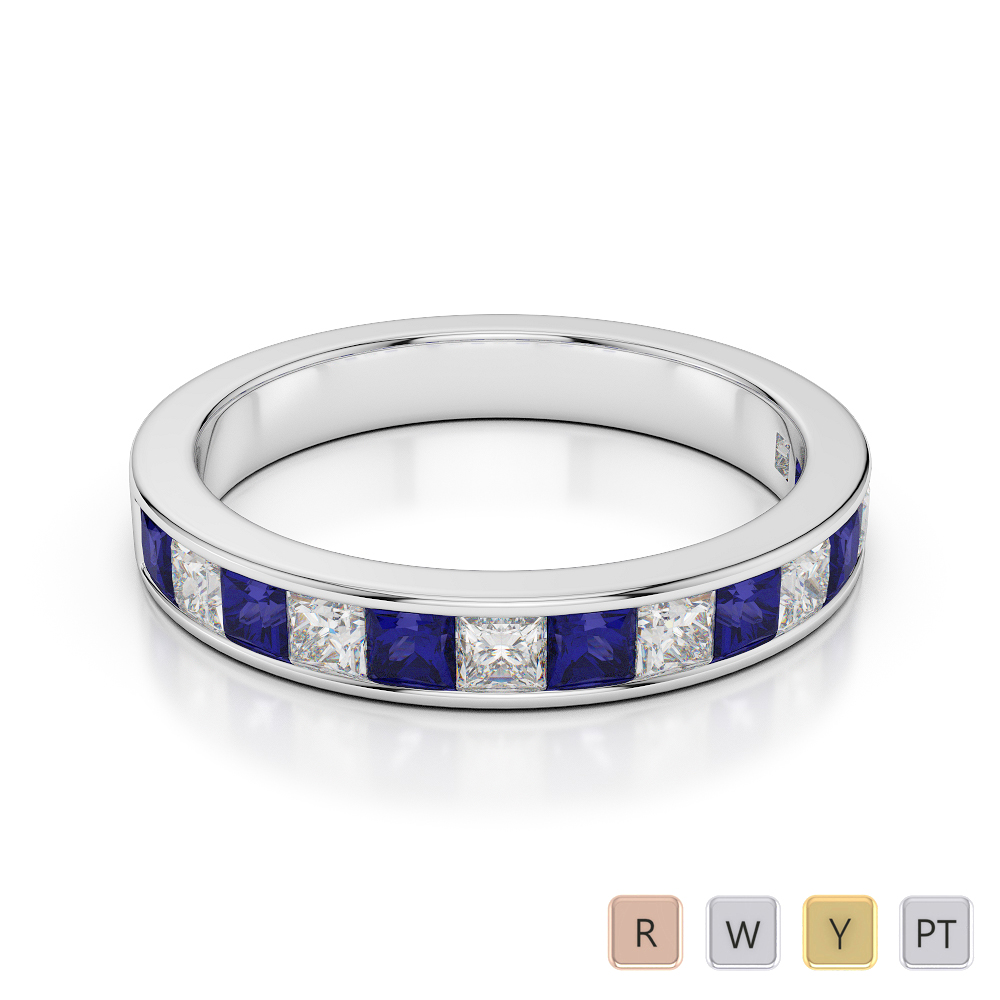
A blue sapphire engagement ring draws from a global supply chain spanning multiple countries and deposits, several of which have been producing for well over a century with no comparable single-point-of-failure risk. If one sapphire source slows down, others continue. There’s no equivalent safety net for tanzanite, precisely because there’s only one source to begin with.
Two Different Kinds of “Special”
This distinction doesn’t make sapphire the lesser choice but simply makes the two stones special for different reasons. Sapphire offers proven durability, a colour that’s remained consistently in demand for centuries, and a supply chain resilient enough that availability isn’t really a long-term question. Tanzanite offers something rarer in the literal sense: a colour-shifting stone tied to a single, depleting source, which is precisely the quality that draws an increasing number of buyers who want their rings to carry that story.
Buying With This in Mind, not as a Warning
None of this is meant to create urgency for its own sake, as that’s precisely the kind of pressure tactic worth being sceptical of in jewellery marketing. But understanding the actual, geologically grounded scarcity behind tanzanite does change how it’s worth thinking about the stone, compared to treating it as simply “a purple-blue alternative to sapphire”.
What’s Actually Worth Asking Before Buying
For anyone seriously considering a tanzanite eternity ring, it’s worth asking where a jeweller sources their stones and whether they can speak knowledgeably about tanzanite’s grading and origin specifically since a market of this nature concentrated around one source rewards genuine specialist knowledge far more than it does for a globally sourced stone like sapphire.
Summing Up
To sum up, most gemstones embody a narrative of beauty, tradition, or significance. Tanzanite carries an unusually literal one: a single hillside, a finite deposit, and a timeline that geologists have been actively debating for years without ever landing on an exact number. Whether that number turns out to be fifteen years or fifty, the underlying fact doesn’t change that Tanzanite is a stone with a genuine ending somewhere out there, worn by people who chose it, at least in part, because of that.