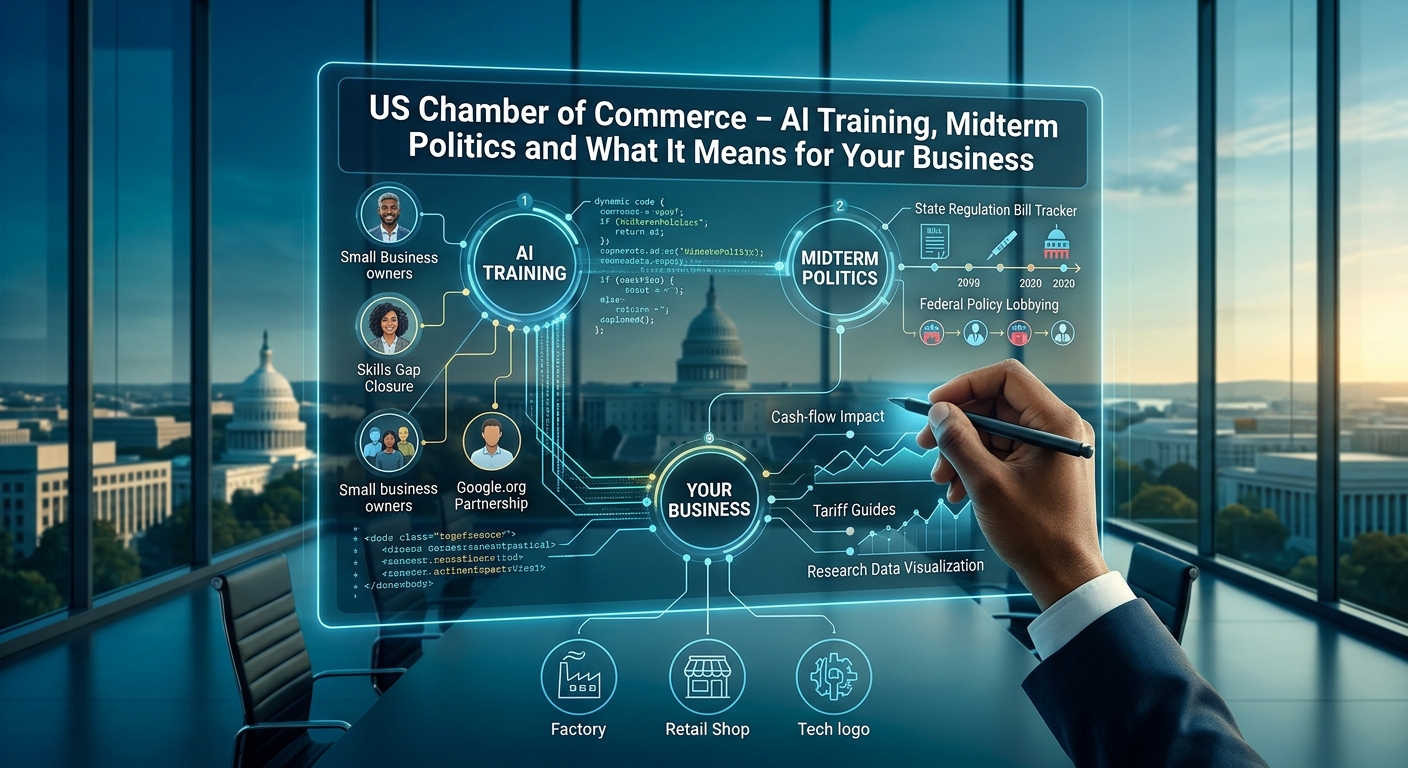
The US Chamber of Commerce rarely trends on social media, yet this year it keeps showing up in places business owners care about: free AI classes, state technology laws, tariff guidance and a busy election season. If you run a company, manage a team or simply follow the economy, understanding what this organization is doing can save you from nasty surprises and point you toward real opportunities.
What the US Chamber of Commerce Actually Does
The US Chamber of Commerce is a private, member-funded business federation based in Washington, D.C. It represents companies of every size, from neighborhood shops to global corporations, along with local chambers and trade associations. Its work falls into four broad areas: lobbying Congress and federal agencies, litigating in court, publishing economic research, and running programs for members.
One common mix-up is worth clearing up. Your town’s chamber of commerce is a separate local organization. Many of them partner with the national body, but they focus on community networking and local issues, while the national group focuses on federal policy and national business conditions.
The US Chamber of Commerce and the AI Skills Gap
Artificial intelligence may be the most practical place to see the Chamber’s influence right now. In April 2026, the organization and its foundation launched Small Business basics, a free national training program supported by Google.org. The goal is to give about 40,000 small businesses a foundation in AI through self-paced online lessons and in-person workshops hosted by local chambers.
The timing makes sense. The Chamber reports that small business use of AI has more than doubled since 2023, with owners applying it to customer service, daily operations and new growth ideas. But using a tool and using it well are different things. A bakery that drafts product descriptions with AI is one story. A bakery that accidentally shares customer data with a careless app is another. Training aims to close that gap.
If you own a small business, a sensible first step is to pick one repetitive task, such as answering routine emails or summarizing invoices, and test an AI tool on it for a month. Measure the time saved before expanding.
Why the US Chamber of Commerce Cares About State AI Laws
Behind the training sits a policy debate. By the Chamber’s own tally, state legislators put forward over 1,000 bills related to AI in 2025. For a company operating in several states, a patchwork of different rules can mean confusing compliance costs, and the Chamber argues that clear, consistent regulation helps smaller firms adopt new technology with confidence.
At a recent roundtable with a California congressman and local business owners, the message was that regulatory certainty matters for continued AI adoption. Critics respond that stronger guardrails protect consumers and workers. Both views are part of a legitimate debate, and the outcome will shape how every business, large or small, uses AI over the next decade.
US Chamber of Commerce Meets Election Season
This is also an election year, and the Chamber is not sitting it out. Recent reporting shows the group stepping up its fall advertising, including issue ads praising incumbents and candidates in several Senate races, and a new six-figure ad buy in Iowa. The organization has historically aligned more often with Republican candidates, though it has also worked with Democrats on issues where interests overlap, such as infrastructure and trade.
Whatever your political leanings, the practical takeaway is that business groups are trying to influence policy on taxes, tariffs, health costs and regulation before votes are cast. If those topics affect your payroll or pricing, it is worth reading the positions of all sides, not just one.

Tariffs, Refunds and the Cash-Flow Question
For importers, nothing has felt more urgent than tariffs. The Chamber has published step-by-step guides on what companies should know after the Supreme Court’s ruling on emergency-power tariffs, including how to check eligibility and prepare for refund processes. It has also spotlighted small firms squeezed by steep metal duties.
A few habits can help any importer right now:
- Keep detailed customs records and invoices organized.
- Review which products you import fall under the contested tariffs.
- Talk to your customs broker or accountant before assuming a refund is coming.
- Build a cash buffer in case the process takes longer than expected.
The Hidden Value – Research and Intelligence
Many owners overlook the Chamber’s research arm. It runs a Global Intelligence Desk that hosts live briefings for members on topics like the Washington outlook, tariffs, investment policy and international developments, with recordings sometimes made available more widely. Its small business surveys track confidence, hiring pressure and capital spending, which can help you compare your own experience with the broader market.
Think of it as a free weather report for your business climate. You still have to decide whether to carry an umbrella, but the forecast helps.
Is a US Chamber of Commerce Membership Worth It?
That depends on what you want. Larger companies often join for policy influence and networking. Small businesses may get more value from training, discounts, education, small business resources and access to a national network.
Before joining, ask yourself:
- Do federal policies, such as trade, tax or labor rules, directly affect my business?
- Would I use the training, research or networking events regularly?
- Do the organization’s public positions broadly align with my own needs?
- Could a local or industry-specific chamber serve me better?
How to Use the US Chamber of Commerce Without Paying a Cent
You do not have to be a member to benefit. A lot of the organization’s material is public, including economic outlooks, small business guides and policy explainers. Here is a simple routine:
- Skim the economic outlook once a quarter before reviewing your budget.
- Check trade and tariff updates before negotiating with suppliers.
- Sign up for a free AI course if you have been putting it off.
- Attend a local chamber event when a national speaker visits your area.
A Balanced Way to Read Any Business Lobby
No organization, including this one, speaks for every business. A restaurant owner, a software founder and a shipping company can have very different interests even when they sit in the same federation. Read its positions the way you would read any advocacy group: appreciate the data, notice the framing, and compare it with other sources, including consumer, labor and independent research groups.
The Bottom Line
The US Chamber of Commerce is more than a Washington lobbying shop. In 2026 it is a trainer of small business AI skills, a voice in the fight over state technology rules, a guide through tariff confusion and an active player in election-year politics. That mix makes it worth watching, even if you disagree with some of its stances.
Begin with something small: choose one resource this week, such as a tariff guide, an AI lesson or an economic outlook, and notice whether it changes a decision you were about to make.