Commercial building exteriors matter a lot; they help shape how customers see the place, they protect structural bits, and they keep the property value from dropping too much. Over time, curtain wall frames, aluminium windows, and shop fronts can end up faded, scratched, discoloured, or just outdated. Mostly because of weather exposure and regular day-to-day wear.Swapping those parts out, though, can get pretty costly, and it can also be disruptive, especially if the business has to stay open while work happens. In that case, on-site spray painting sounds like a more workable option. It restores the existing surfaces with a fresh, durable coating instead of full replacement. Methods like PVF2 spraying, curtain wall spraying and shopfront spraying can let commercial property owners modernise the building without wasting the materials already there.
Still, is on-site spray painting really the right fix for every commercial property? It depends, so looking at the advantages, what it can be used for, and where it doesn’t quite fit, helps businesses decide with a bit more confidence.
What Is On-Site Spray Painting in Commercial Property Refurbishment?
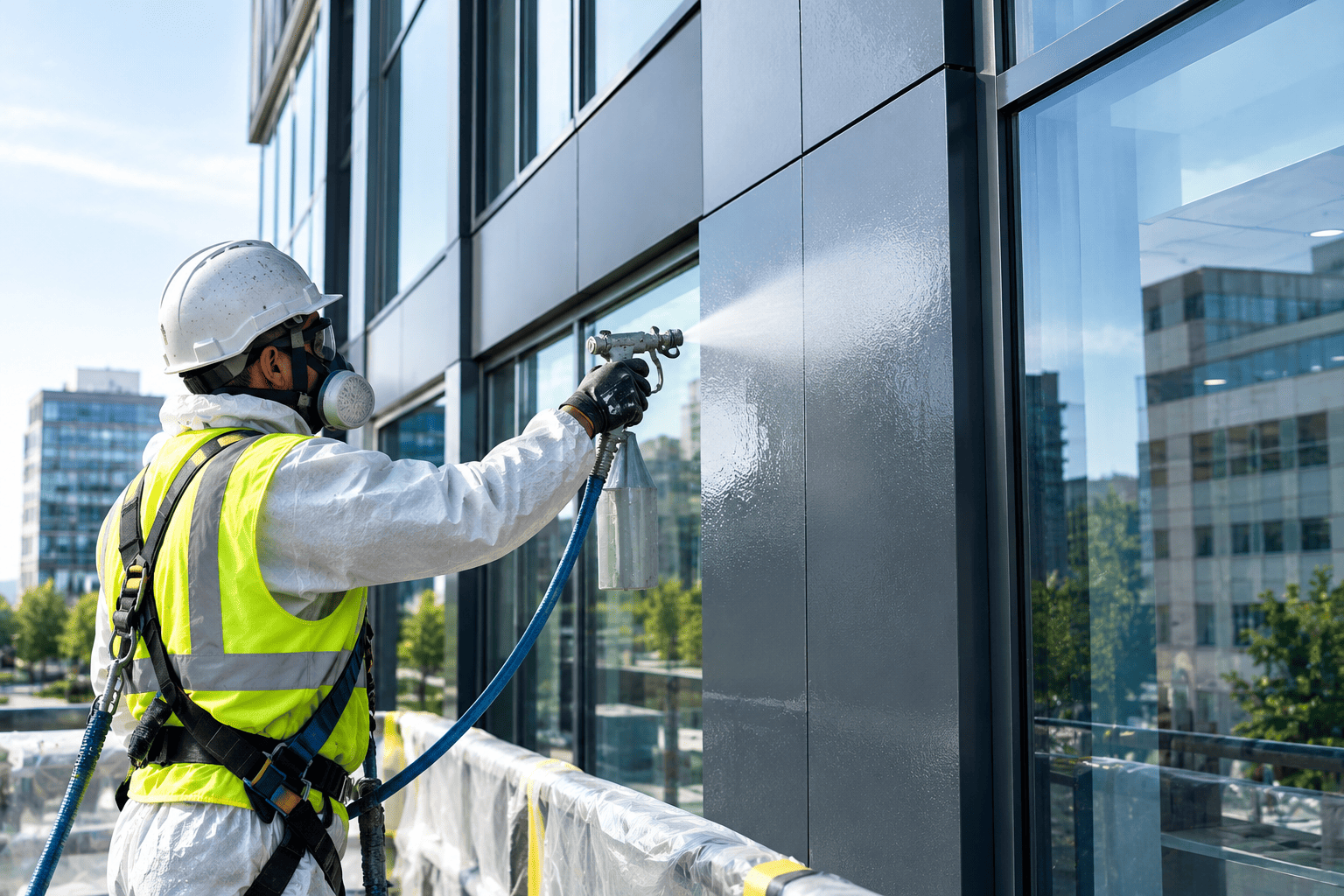
It lets trained technicians refurbish suitable existing surfaces, and that can include aluminium frames, curtain wall profiles, shop fronts, and doors.
Compared with older brush or roller painting, pro spray application can give a smoother, more even look over big or awkward areas. It tends to be a big deal for commercial buildings, because taking components off and then moving them around would mean extra cost.
Depending on the surface material and how it’s currently doing. The typical method goes through cleaning first, then removing loose or tired coatings, then surface prep and masking. After that, a matching primer is applied only where it’s needed, and then the final coating is sprayed on.
So for offices, retail premises, and other commercial properties, on-site spray painting offers a straightforward way to give the building a new face.
How Can Curtain Wall Spraying Improve Commercial Building Exteriors?
With curtain wall spraying, the goal is to restore properly selected existing frame surfaces by applying a coating professionally specified for the job. It’s not just about making things “pretty” either, though. Property owners can also use it as a practical way to tweak the exterior colour palette. The building better matches a new corporate identity or that more contemporary architectural style you’re aiming for.
Some of the main benefits people notice are
1. Enhanced appearance: It refreshes faded, worn, or dated aluminium frames and brings back a cleaner visual finish.
2. Less replacement pressure: In many cases, it helps reduce the need to remove otherwise serviceable components.
3. Design flexibility: Suitable frames can be refinished in a different shade without replacing the whole system.
4. Lower day-to-day disruption: The work is often scheduled around business hours and around building access requirements, so tenants and operations aren’t hit as hard.
5. More efficient refurbishment: It can also cut down material waste compared with replacing functional facade elements,
Is Shop Front Spraying a Cost-Effective Alternative to Replacement?
A shop front is often the first physical direct interaction customers get with a business. If it looks faded or worn, even a retail interior that’s actually well maintained can start to feel ignored.

The main benefits of shopfront spraying are usually pretty practical, like the following:
- Giving an older retail frontage a renewed look
- Building a uniform look across several branches or locations
- Getting the shop front to match new branding, signage and colour direction
- Cutting down waste, especially when the existing components are still perfectly serviceable
- Sometimes it can also shorten the refurbishment timeline compared with full replacement
With shopfront spraying, retailers, restaurants, showrooms and other commercial spaces can refresh the exterior frames, entrance surrounds and suitable metal or surfaces that are already coated.
What Is PVF2 Spraying, and When Should Businesses Consider It?
So basically, PVF2 spraying means you’re putting on a polyvinylidene fluoride-type layer, usually PVDF, onto the right architectural surfaces. In building work, this is chosen because the coating tends to handle weather fairly well. This keeps its colour steadier and can give better long-term exterior results when it’s chosen properly and then installed correctly.
For businesses doing commercial property refurbishment, PVF2 spraying might come up when there’s a need for a coating system that matches the architectural metalwork.

Some of the usual potential advantages are the following:
- Weathering resistance, and also solid help against ultraviolet exposure
- Good colour retention, but only if the coating system is selected well for the situation
- A more professional appearance on the right exterior metal surfaces
- It can also support longer-term facade maintenance plans, instead of constant touch-ups
Businesses should confirm the exact coating chemistry and the performance claims with their contractor. Not just assume every product labelled PVF2 does the same job or provides the same protection.
Which Factors Determine the Quality and Durability of Spray Painting?
Honestly, the paint is only part of the story. Even a high-performance coating can start failing too early if the surface was not handled properly or if the spray conditions are just not right.
Before a refurbishment job is signed off, companies should think about these points, maybe in a slightly more careful way:
1. Surface condition: Any existing coating, corrosion, scratches, and those damaged spots need a proper review before anything starts.
2. Surface preparation: Cleaning, abrasion, and priming should be done according to what the coating system actually calls for.
3. Coating compatibility: The new product must match the existing substrate, and it should also work with whatever coating is already there.
4. Application expertise: Skilled technicians can produce steadier coverage and a smoother, more uniform result, especially when dealing with detailed architectural shapes.
5. Weather and curing conditions: Temperature, humidity, wind, and moisture do not just “affect” things. They can meaningfully change how the spray lays down and how long curing takes.
6. Maintenance requirements: Planned inspections and the right cleaning routine help protect the finish and catch early signs of deterioration.
Businesses should ask for clear and precise details about the proposed coating, the expected service life, what maintenance will be needed, and the warranty terms. This helps to compare options in a more dependable way than going by price only.
Conclusion: Can On-Site Spray Painting Be the Best Solution?
For commercial property refurbishment, on-site spray painting can be a cost-effective and practical option. Especially when the existing parts stay in good condition. With curtain wall spraying, shopfront spraying, and suitable PVF2 spraying systems, businesses can give the exterior a fresher look, tune architectural colours, and sidestep unnecessary replacement.
The best outcome depends on the building’s current state, the coating demands, and how long you expect the finish to last. A proper site inspection, choosing the right products, and doing careful preparation makes a durable result more likely. Without that, it can go sideways, not instantly but over time.
For commercial property owners and facilities managers, it helps to compare refurbishment and replacement routes before committing to major works. That way you can balance appearance, costs, day-to-day operations, and longer-term building performance. Sometimes “better” is not the obvious one.
Frequently Asked Questions
1. How long does on-site spray painting last on commercial buildings?
It depends on the coating system, how well the surface is prepared, environmental exposure, application quality, and what maintenance looks like. A professionally specified exterior coating can give long-term performance. But businesses should still ask for product-specific durability information and the warranty details directly from the contractor.
2. Can curtain wall spraying be carried out without removing the glass?
Often yes. In many situations, the curtain wall frames can be sprayed while the glazing stays where it is. Still, the glass and nearby areas need careful masking and protection. Whether it’s feasible really depends on the facade layout, access requirements, and the condition of the existing frames.
3. Is PVF2 spraying suitable for every aluminium shop front?
Not automatically. Suitability depends on the aluminium substrate, whether the coating is already there, the surface condition, and the needs of the selected coating system. Contractors should verify compatibility and whether the planned PVDF-based product fits this on-site approach.
4. Is shopfront spraying cheaper than replacing a shopfront?
It can be. Shopfront spraying may cost less than replacement when the existing framework is stable, and the main need is cosmetic improvement. Getting detailed quotations is usually the fastest way to see what fits each property best.