Key Takeaways
- Arabic LMS development is product engineering, not translation. Plan Arabic at the architecture stage and you avoid costly rework after launch.
- Native right-to-left (RTL) design improves efficiency. Fewer navigation errors mean fewer support tickets for your IT and academic teams.
- Localization improves the user experience. Terminology, dates, numbers, notifications and assessments all need adapting, then testing with real users.
- Integration with school systems removes duplicate data entry and keeps one reliable student record.
- Choose custom or ready-made based on genuine gaps, not on technology for its own sake.
- Institutions that get bilingual learning right stay competitive as digital education in the UAE keeps growing.
Picture a Grade 7 student in Dubai opening the learning platform on her phone. The menu is in Arabic. The quiz instructions are in Arabic. But the progress bar fills left to right, a line of English abbreviations scrambles the punctuation of her homework question, and her father’s parent-portal email arrives with the greeting on the wrong side. Nothing is technically missing. The platform just wasn’t built for her.
That’s the gap UAE schools, universities and training providers hit when they treat Arabic as a translation task. Changing the interface language doesn’t fix Arabic typography, right-to-left navigation, assessment formats, curriculum terminology or Arabic-language AI features.
Arabic LMS development is a product-engineering and localization challenge. A bilingual platform has to be designed around how people learn, teach, communicate and find information in both languages.
This guide covers what that means in practice: localization, interface architecture, content, school-system integration, privacy, costs and the build-or-buy decision. It’s written for education decision-makers across Dubai and the UAE who want to make that call with clear eyes.

Why Arabic LMS Development Matters in the UAE
Arabic LMS development matters in the UAE because students, parents and staff use both Arabic and English every day. A platform that serves only one language well creates unequal access to learning.
A multilingual education environment with varied institutional needs
The UAE education market isn’t one market. Private schools run British, American, Indian, IB and Ministry of Education curricula side by side. Universities teach in English but communicate with parents and government bodies in Arabic. Vocational providers train workforces who read at different levels in each language. Corporate L&D teams need onboarding content that works for a Dubai-based engineer and a Sharjah-based front-desk team. EdTech businesses want to launch branded products for all of them.
English-only functionality doesn’t fully serve this mix. A parent may prefer Arabic for report cards and attendance alerts while the child studies in English. A teacher may write feedback in Arabic on a course delivered in English. An administrator may need reports in both. Each institution also has its own curriculum, learning materials, user roles and communication habits, so one fixed template rarely fits.
The shift from translated interfaces to localized learning experiences
Three terms get mixed up, so it helps to separate them:
- Translation converts text from one language to another.
- Localization adapts terminology, formats, layouts, tone and examples to the people using the product.
- Product adaptation changes workflows and features, such as a parent portal in Arabic or Arabic-language assessment marking.
Language choice affects comprehension, engagement, accessibility and assessment fairness. A student who has to decode an awkward instruction before answering a question is being tested on the interface, not the subject. That’s why institutions increasingly look for custom Arabic LMS development instead of a one-size-fits-all learning platform.
Translation vs Localization in Bilingual Learning Platforms
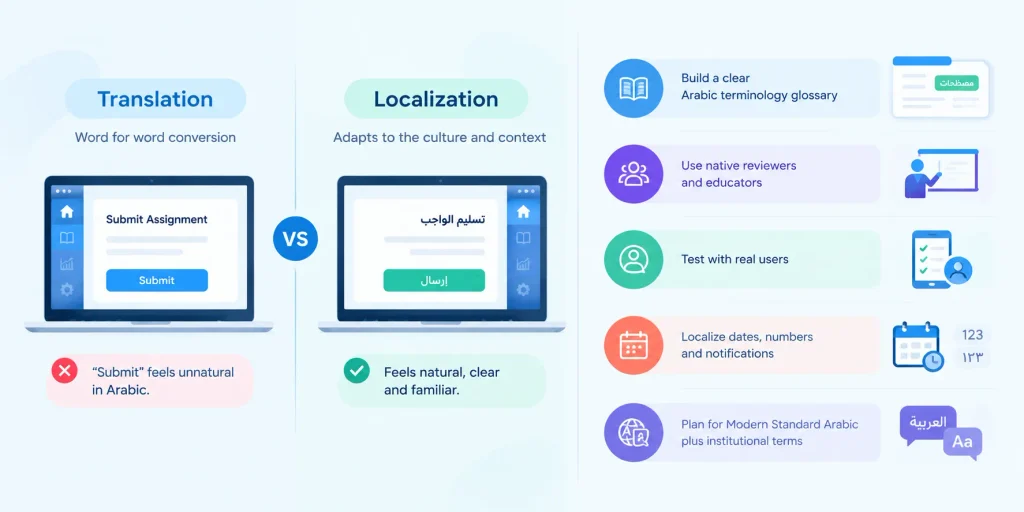
Translation converts words from one language to another. Localization adapts the whole experience, including terminology, layout, formats, tone and examples, so it feels natural to the people using it.
Why direct translation creates usability problems
Literal translation fails in small, irritating ways. A button labelled “Submit” becomes a word that sounds like filing a legal document. An assignment “drop box” is translated word for word and means nothing to a teacher. Navigation labels pick up different Arabic equivalents on different screens, so nobody can tell whether “Grades” and “Marks” lead to the same page.
Assessment is where it costs most. Translate the quiz instructions but leave an English example sentence, Western names and a question format built around English spelling, and Arabic-speaking students end up decoding the test instead of answering it. Feedback comments have the same problem. Tone matters too, since formal educational Arabic reads differently from casual English app microcopy.
Arabic LMS localization best practices for UAE institutions
These Arabic LMS localization best practices apply whether you build or buy:
- Create one Arabic terminology glossary covering subjects, grades, assessment types and administrative workflows. Lock it before screens are designed.
- Use native Arabic reviewers and working educators to validate content and instructions. Linguists catch grammar; teachers catch confusing instructions.
- Test both interfaces with real users. A linguistic review alone won’t reveal that a menu label is ambiguous.
- Localize the details: dates, numbers, notifications, reports and help content. Let institutions choose Western or Arabic-Indic numerals, and decide how Gregorian and Hijri dates appear.
- Plan for Modern Standard Arabic plus institutional terminology. Don’t assume one register or dialect suits every learner.
How to measure localization quality
Track task-completion rates, navigation errors, comprehension checks, support requests and user feedback. Then compare Arabic and English users side by side. If Arabic users need twice as many support tickets to submit an assignment, you’ve found a usability gap, and the cause usually isn’t the language itself.
Quick Question: “Is machine translation enough for an Arabic LMS?”— No. It’s a useful first draft for large volumes of text, but it can’t validate subject-specific vocabulary, tone or instructions. Educators should review anything students will be assessed on.
Right-to-Left LMS Interface Design and Technical Requirements
Right-to-left LMS interface design means mirroring layouts, navigation and progress indicators for Arabic readers while keeping universal controls, mixed-direction text and numbers readable and consistent.
Building a genuine Arabic-first user interface
Arabic reading direction touches nearly everything: menus, page layouts, breadcrumbs, progress indicators and course dashboards. A progress bar that fills left to right in an Arabic interface feels backwards to the people using it. Tables should start from the right. Sidebars move to the right.
Mixed-direction text is where many platforms break. Arabic sentences regularly contain English abbreviations, URLs, course codes or numbers. Without correct bidirectional handling, a closing full stop can jump to the wrong end of the line, or a course code like “BIO-101” can reverse itself. Typography matters too: Arabic needs generous line spacing and fonts designed for legibility on small screens, because tightly set text that looks fine in English becomes hard to read.
Right-to-left LMS interface design across devices
RTL support has to reach web portals, mobile applications, push notifications, forms, charts and downloadable learning materials. A common failure: the web portal is flawless, but generated PDF certificates print Arabic names as disconnected letters because the PDF engine can’t shape Arabic script properly. Another: charts on the teacher dashboard keep their axes in English order.
Mirror back arrows and navigation order, but keep universal icons like play buttons unmirrored. If you plan native apps, work with a mobile application development service in Dubai that tests Arabic layouts on real devices, since emulators hide rendering problems. Test across browsers, screen sizes and operating systems before launch.
Technical considerations for Arabic text
Under the hood, a few decisions decide whether Arabic works reliably:
- Unicode (UTF-8) end to end, from the browser to the database, including collation rules for Arabic sorting.
- Search normalization. Arabic has letter variants (أ, إ, آ, ا), optional diacritics, and similar-looking endings. Search that treats them as different words will miss results students are looking for.
- Mixed-language storage. Names, course titles and comments in both languages should be searchable and exportable.
- Real-world text tests: type, edit, copy, paste, search and export Arabic throughout the platform.
- Accessibility. Check keyboard navigation order in RTL, colour contrast against WCAG 2.2 guidance, and screen-reader behaviour with Arabic voices.
Bilingual LMS Development Best Practices for Better Learning Outcomes
Bilingual LMS development best practices centre on one idea: both languages should deliver the same learning quality, so a student’s outcome never depends on which language they chose.
Design language switching around the learner
Let users switch language without losing course progress, a half-finished quiz or a saved draft. That sounds obvious until a student toggles to Arabic mid-assessment and the timer resets.
Preferences differ by role. A student may study in English while a parent reads in Arabic. Store language settings per user and carry them into emails, SMS and push notifications.
Keep learning experiences consistent across Arabic and English
Align learning objectives, grading criteria, course structure and assessment difficulty across both languages. Sometimes a localized example works better than a direct translation. A word problem about a local market may land better than one about a US shopping mall.
Version control matters here. When the English course updates in March and the Arabic one in May, students in the two groups study different material. Build workflows that flag out-of-sync content so nothing drifts quietly.
Validate bilingual functionality before launch
Run usability sessions with Arabic-speaking and English-speaking users. Test assignments, quizzes, certificates, reports and notifications in both languages. The benchmark is simple: can both groups finish the same core tasks with comparable ease? If they can’t, fix that before go-live, not after the first term.
The Biggest Challenges of Arabic E-Learning Platform Development
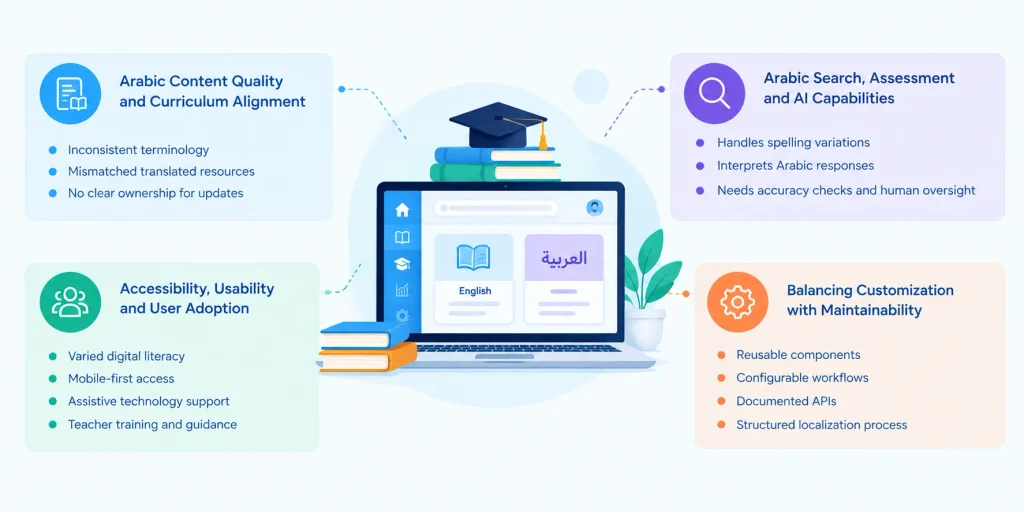
The challenges of Arabic e-learning platform development fall into four areas: content quality, Arabic language technology, user adoption and long-term maintainability.
Arabic content quality and curriculum alignment
Many institutions discover their Arabic content is inconsistent. Subject vocabulary differs between teachers, translated resources use mismatched terms, and nobody owns updates. The fix is educator review and curriculum mapping, so each Arabic resource ties to a defined learning outcome and has a named owner.
Arabic search, assessment and AI capabilities
Arabic search has to cope with spelling variations. Assessment tools need to interpret Arabic responses sensibly. AI features add another layer: AI-generated Arabic explanations, feedback or quiz questions can sound fluent and still be wrong, so they need accuracy checks and human oversight before reaching students. It also helps to separate basic Arabic-language support (display, input, search) from advanced Arabic natural language processing (understanding meaning, grading open answers, tutoring), which takes considerably more effort to do well.

Accessibility, usability and user adoption
Digital literacy varies across teachers and parents. Most families access the platform on mobile first. Some learners rely on assistive technology. A confusing interface raises support requests and lowers adoption, and teacher training often makes the difference between a platform that gets used and one that gets worked around.
Balancing customization with maintainability
Institution-specific changes shouldn’t make the LMS painful to upgrade. This is a classic product engineering services Dubai concern: build reusable components, configurable workflows, documented APIs and a structured localization process, so a new campus or curriculum becomes a configuration change rather than a code rewrite.
Arabic LMS Integration with School Management Systems
Arabic LMS integration with school management systems connects learning data with student information, admissions, attendance and assessment records, so staff enter data once and families see one consistent record.
Connect the LMS with existing education systems
Typical integration points include student information systems, admissions, attendance, gradebooks, parent communication tools and identity management. Without them, staff re-key enrolments, teachers maintain two attendance records, and student information fragments across platforms. Connected systems reduce duplicate data entry and give leadership a single view of each learner.
Use standards and APIs for reliable data exchange
Reliable integration starts with well-designed API development services in Dubai and, where the systems support them, education standards such as LTI (for launching external learning tools) and OneRoster (for exchanging rosters and grades). Implementation details decide success: identity matching between systems, field mapping, how Arabic and English names are stored, and synchronization schedules.
Be realistic about compatibility. It depends on vendor support, which APIs are exposed and what the licence allows. Confirm those early, before design is locked.
Protect student data across connected platforms
Student data is sensitive, and every connection widens the exposure. Use role-based permissions, encryption in transit and at rest, audit trails, data minimization and secure authentication. Test integrations for data accuracy, failure recovery and access control, including what happens when a sync fails halfway.
Regulation deserves its own check. The UAE has a federal personal data protection law (Federal Decree-Law No. 45 of 2021), and education authorities such as Dubai’s KHDA set expectations for private schools. Requirements vary by institution type and data location, so verify what applies with legal counsel instead of assuming.
Quick Question: “Do LTI and OneRoster work with every school management system?”— No. They only work where both systems support them and the vendor enables the required features or licences. Confirm support during discovery.
Essential Features of an Arabic-English LMS for UAE Institutions
An effective bilingual LMS combines core learning tools with Arabic-English content management, then adds advanced capabilities only where they serve a measurable goal.
Core learning and administration features
- Course creation, learning paths, assignments, quizzes, grading, certificates and progress tracking
- Teacher dashboards, student profiles, parent access and administrative reporting
- Arabic-English content management with consistent language switching
Advanced features that support institutional growth
- AI-assisted tutoring and assessment, with human oversight
- Learning analytics and intervention alerts for students falling behind
- Mobile access, notifications and integration with existing education systems
- Configurable workflows for different curricula, campuses and user roles
Let institutional needs and measurable objectives drive feature selection. Technology added for its own sake just creates more to maintain.
Custom Arabic LMS vs Ready-Made Platforms
Choose a ready-made LMS when a configurable product meets your bilingual needs with light customization. Choose custom development when requirements create a gap existing products can’t reasonably close.
When an existing LMS may be sufficient
A configurable off-the-shelf platform can work well when your needs are standard. It offers faster implementation, predictable licensing and a maintained feature set. Check maintenance costs, available integrations and the quality of its Arabic support before committing.
When custom Arabic LMS development makes sense
Custom builds make sense for advanced RTL requirements, specialized Arabic learning workflows, proprietary content, AI capabilities or multi-system integration. White-label development can suit organizations launching their own branded learning products. If you’re weighing this path, a custom LMS development company in Dubai can help you test it against your requirements.
| Factor | Ready-made LMS | Custom Arabic LMS |
|---|---|---|
| Time to launch | Faster | Longer |
| Arabic/RTL depth | Varies by vendor | Built to your needs |
| Upfront cost | Lower | Higher |
| Long-term flexibility | Limited by vendor roadmap | High |
| Vendor dependency | Higher | Lower |
What to Look for in an Arabic LMS Development Partner
The right partner can show production experience with Arabic interfaces, a structured delivery process and a clear plan for support after launch.
Evaluate localization and technical expertise
Ask for evidence of Arabic interfaces in production, RTL testing practices, bilingual content workflows and mobile usability work. Review their integration capability, security practices, testing procedures and documentation. A capable partner shows you its process, not just a portfolio. If you’re comparing options, start with a software solutions company in Dubai that can speak to these points specifically.
Assess implementation and long-term support
- Confirm discovery, prototyping, pilot testing, training, maintenance and post-launch improvements are covered.
- Request a clear scope, milestone plan, acceptance criteria and support terms.
- Ask how they measure adoption, learner progress, system reliability and localization quality.
How SISGAIN Technologies Approaches Arabic LMS Development
Building education software around UAE-specific requirements
SISGAIN Technologies is an education software development partner for organizations that need custom learning platforms shaped around their own operations and localization needs. The approach starts with bilingual product planning, RTL-ready interfaces and configurable learning workflows, with integration into existing school systems where technically supported.
The development process covers discovery, architecture, UI/UX design, development, quality assurance, deployment and ongoing support. AI features, security controls and scalability are scoped from requirements and measurable learning objectives, not added for show.
Conclusion: Build for Arabic Learning, Not Just Arabic Text
Successful Arabic LMS development covers language, interface architecture, pedagogy, integration, privacy and ongoing evaluation. Native RTL support, culturally appropriate content, consistent bilingual experiences and secure integrations are what separate a platform people use from one they tolerate.
Pick an off-the-shelf or custom solution based on real requirements and long-term goals. Then plan a bilingual platform that supports your learners, your educators and your growth.
Frequently Asked Questions
1. What is Arabic LMS development?
It’s building or adapting a learning management system for Arabic and English users, covering RTL interfaces, localized content, Arabic search, assessments and integrations, rather than simply translating an existing English platform.
2. Why isn’t translation enough for a bilingual LMS?
Translation changes words only. Localization also adapts terminology, layout direction, dates, numbers, examples and assessments, so Arabic and English learners complete the same tasks with equal ease and comprehension.
3. What is right-to-left (RTL) interface design in an LMS?
It mirrors layouts, menus, progress bars and navigation for Arabic readers, while handling mixed-direction text, numbers and universal icons correctly across web, mobile, notifications, forms, charts and downloadable documents.
4. How do you measure Arabic localization quality?
Compare Arabic and English users on task-completion rates, navigation errors, comprehension, support requests and feedback. Large gaps between the two groups point to usability or terminology problems worth fixing.
5. Can a bilingual LMS integrate with school management systems?
Usually yes, through APIs and standards such as LTI or OneRoster, where both systems support them. Compatibility depends on vendor APIs and licensing, so confirm early during discovery planning.
6. What are the biggest challenges of Arabic e-learning platform development?
Common challenges include inconsistent Arabic terminology, curriculum alignment, Arabic search with spelling variations, reliable AI-generated content, user adoption, and keeping customizations maintainable as the platform grows and upgrades.
7. Should we choose a custom or ready-made Arabic LMS?
Choose ready-made when a configurable product meets your needs. Choose custom when advanced RTL, proprietary content, AI features or multi-system integration create gaps existing platforms cannot reasonably close.
8. Is AI-generated Arabic content safe to use in an LMS?
Only with oversight. AI Arabic can sound fluent yet be inaccurate, so institutions need accuracy checks, educator review and clear escalation paths before AI explanations, feedback or quizzes reach students.
9. How do you protect student data in an Arabic LMS?
Use role-based permissions, encryption, audit trails, data minimization and secure authentication. Test integrations for accuracy and failure recovery, and verify UAE data protection and education-authority requirements with legal counsel.
10. What should we look for in an Arabic LMS development partner?
Ask for evidence of Arabic and RTL production experience, bilingual content workflows, integration and security capability, a clear scope with acceptance criteria, pilot testing, training, and defined post-launch support.